Game Mechanics List: 20 Game Mechanics Explained (With Prompts to Try)
What are game mechanics? A list of 20 common game mechanics, from jumping and merging to upgrades and boss fights, each explained in plain words with a prompt you can try on Flikk.

In this article
Jump. Merge. Upgrade. Dodge. Every game is built from a few simple actions and rules, and those are called game mechanics. Once you know them, you can describe almost any game in one sentence, and making your own gets a lot easier.
The short answer: game mechanics are the actions players can take and the rules that respond to them, like jumping, shooting, matching, collecting or upgrading. Most games combine two to four mechanics. Below are 20 common ones, explained in plain words, each with a prompt you can paste into Flikk to try it.
Quick note: Flikk is our app. We tested three prompts from this post in Flikk and show the free game plans they got (marked ✅). The other prompts are ideas to try.
Key takeaways
- A game mechanic is an action plus a rule. "Tap to jump" is an action. "If you fall, you lose a life" is the rule that makes it matter.
- Most games mix two to four mechanics. For example: run, jump and collect.
- Start with one mechanic. Get one action to feel good, then add more.
- Name the mechanic in your prompt. In our test, a vague prompt still got a full game plan, but Flikk picked the mechanics. When we named them, the plan used exactly the ones we asked for.
- One mechanic can grow into a full game. We asked only for aiming and shooting, and the plan added power-ups, boss fights and unlocks.
What are game mechanics?
Game mechanics are the building blocks of a game: what the player can do and how the game reacts. Jumping over a gap, matching three gems, buying a faster machine: each of these is a mechanic.
Mechanics are different from the theme. A game about pirates and a game about space can use the exact same mechanics. The theme is what it looks like, the mechanics are how it plays. The action a player repeats most is the core loop, which we explain in the most important part of game design.
All 20 game mechanics at a glance
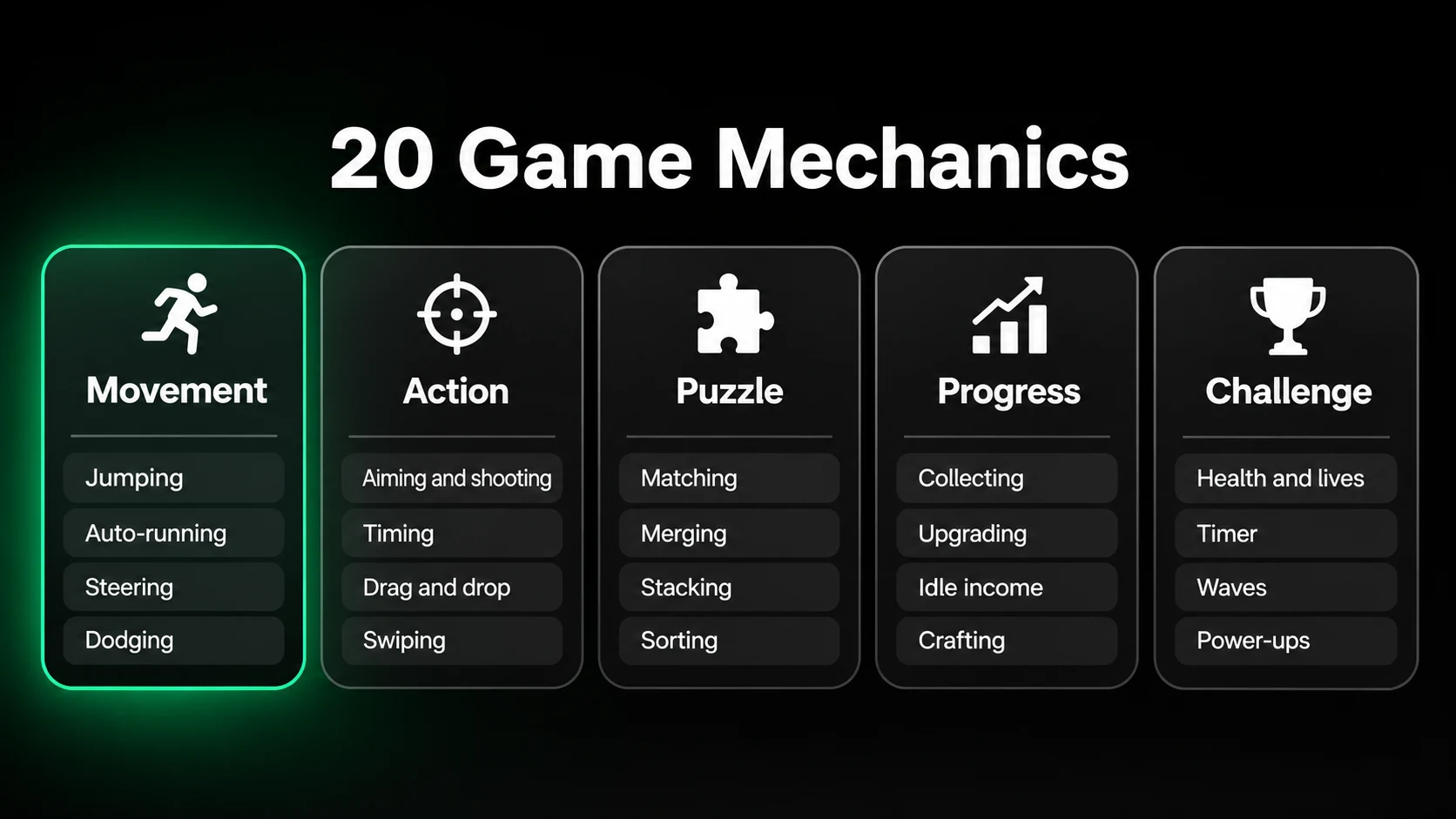
| # | Mechanic | What the player does | Fits genres like |
|---|---|---|---|
| 1 | Jumping | Jumps over gaps and onto platforms | Platformer, runner |
| 2 | Auto-running | Keeps moving forward and reacts | Endless runner |
| 3 | Steering | Steers left and right | Racing |
| 4 | Dodging | Avoids things coming at them | Arcade, bullet hell |
| 5 | Aiming and shooting | Aims and fires at targets | Shooter, tower defense |
| 6 | Timing | Taps at exactly the right moment | Rhythm, arcade |
| 7 | Drag and drop | Moves things to the right place | Puzzle, sorting |
| 8 | Swiping | Swipes to move, slice or throw | Casual, arcade |
| 9 | Matching | Lines up three or more of the same | Match-3 |
| 10 | Merging | Combines two of the same into something better | Merge |
| 11 | Stacking | Places things on top of each other | Arcade, casual |
| 12 | Sorting | Puts things into the right groups | Puzzle |
| 13 | Collecting | Picks up coins, items or creatures | Almost every genre |
| 14 | Upgrading | Spends coins to get stronger or faster | Tycoon, idle, survival |
| 15 | Idle income | Earns while not tapping | Idle, tycoon |
| 16 | Crafting | Combines resources into new items | Survival, cozy |
| 17 | Health and lives | Loses health or lives when hit | Action, platformer |
| 18 | Timer | Finishes before time runs out | Puzzle, cafe, racing |
| 19 | Waves | Survives groups of enemies that get harder | Tower defense, survival |
| 20 | Power-ups | Grabs a short boost | Arcade, runner, match-3 |
Movement mechanics
1. Jumping
The player jumps to cross gaps, climb platforms or hop over enemies. Jumping is the heart of every platformer: the height, speed and landing decide how the whole game feels.
Prompt to try: "A 2D platformer where a little fox jumps across floating islands and collects berries."
More: how to make a platformer game.
2. Auto-running
The character runs forward on its own, and the player only reacts: jump, slide or switch lanes. It's perfect for phones, because one thumb is enough.
Prompt to try: "A 3D endless runner where a raccoon runs through a city at night and swipes left and right to dodge trash cans."
3. Steering
The player steers a car, boat, sled or plane left and right to stay on track. Speed goes up, and the turns get tighter.
Prompt to try: "A 3D racing game where I steer a go-kart around a desert track and boost on the ramps."
More: how to make a racing game.
4. Dodging
Things fly at the player, and they have to get out of the way. The fun comes from the near misses.
Prompt to try: "A 2D game where I move a tiny spaceship to dodge falling meteors, and the meteors get faster every 20 seconds."
More: how to make a bullet hell game.
Action mechanics
5. Aiming and shooting
The player aims at targets and fires. It can be fast (shoot everything) or slow (one careful shot).
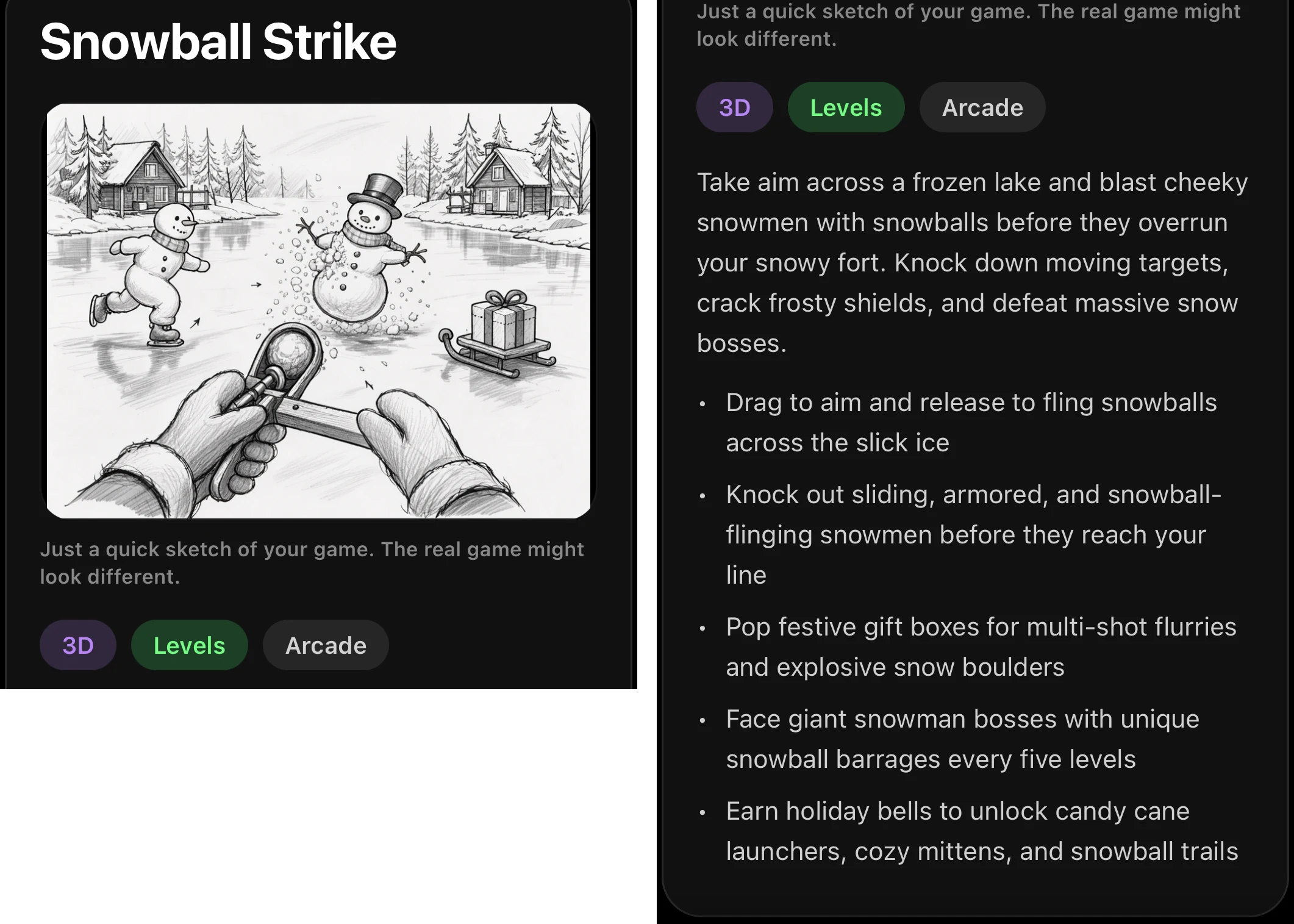
Prompt we tested ✅: "A 3D game where I launch snowballs at snowmen standing on a frozen lake."
Flikk turned it into Snowball Strike, tagged 3D, Levels and Arcade. The plan starts with the mechanic we asked for: "Drag to aim and release to fling snowballs across the slick ice." Then it adds more on its own: snowmen you have to knock out "before they reach your line", gift boxes for "multi-shot flurries and explosive snow boulders" (power-ups), giant snowman bosses "every five levels" and holiday bells to unlock new launchers, mittens and snowball trails.
6. Timing
The player has to tap at exactly the right moment: to hit a beat, stop a moving bar or catch something in the air. Easy to learn, hard to do perfectly.
Prompt to try: "A 2D game where I tap to drop a slice of cake onto a moving plate, and the plate gets faster every level."
7. Drag and drop
The player picks something up and puts it in the right place. It's calm and works great on touchscreens.
Prompt to try: "A cozy 2D game where I drag furniture into an empty room to match a picture."
8. Swiping
The player swipes to move, slice, throw or switch lanes. A swipe feels faster and more physical than a tap.
Prompt to try: "A 2D game where I swipe to slice flying fruit but must not slice the bombs."
More on touch controls: mobile game controls.
Puzzle mechanics
9. Matching
The player lines up three or more of the same thing, and they disappear. New pieces fall in, and chain reactions bring big rewards.
Prompt to try: "A match-3 game with sweets in a candy shop, and a new candy jar to fill every 5 levels."
More: how to make a match-3 game.
10. Merging
Two of the same thing combine into one better thing. The player keeps merging to reach the biggest item.
Prompt to try: "A merge game where two of the same seeds merge into a bigger plant, up to a giant magic tree."
More: how to make a merge game.
11. Stacking
The player places blocks, boxes or cakes on top of each other. The higher the tower, the harder it gets to keep it balanced.
Prompt to try: "A 3D game where I stack pancakes as high as I can before the tower falls."
12. Sorting
The player puts things into the right groups: colors into tubes, toys into boxes, letters into mailboxes.
Prompt to try: "A 2D puzzle game where I sort colored balls into tubes so each tube has one color."
Progress mechanics
13. Collecting
The player picks things up: coins, stars, gems, cards or creatures. Collecting gives players a reason to explore and to keep playing.
Prompt to try: "A calm 3D game where I walk along a beach and collect shells for my collection book."
14. Upgrading
The player spends what they earn to get faster, stronger or richer. Upgrades are what make players say "just one more round".
Prompt to try: "A 3D game where I run a lemonade stand and buy upgrades like a bigger jug and a faster juicer."
More: game progression and how to make a tycoon game.
15. Idle income
The game keeps earning coins even when the player isn't tapping. When they come back, there's a pile waiting to spend.
Prompt to try: "An idle game where my bakery bakes bread on its own and I hire more bakers to bake faster."
More: what is an idle game?
16. Crafting
The player gathers resources and combines them into new items, like wood and stone into an axe.
Prompt to try: "A 3D survival game where I gather wood and stone on an island and craft tools to build a shelter."
More: how to make a survival game.
Challenge mechanics
17. Health and lives
The player can get hit a few times before they lose. Health gives the player room to make mistakes, and makes danger feel real.
Prompt to try: "A 2D platformer where a knight has three hearts and loses one every time a slime touches him."
18. Timer
The player has to finish before time runs out. A timer adds pressure, even to a calm game. Keep it gentle in cozy games.
Prompt to try: "A 2D game where I have 60 seconds to find all the hidden cats in a busy park."
More: how to make a cozy game.
19. Waves
Enemies come in groups, and every wave is a little harder than the last. Between waves, players can catch their breath and upgrade.
Prompt to try: "A tower defense game where I build cannons to stop waves of robots, with a bigger robot every 5th wave."
More: boss fights and the difficulty curve.
20. Power-ups
The player grabs a short boost: a shield, a magnet, double coins or extra speed. Power-ups make a game feel exciting for a few seconds.
Prompt to try: "A 3D endless runner where a magnet power-up pulls in all coins for 10 seconds."
More: power-ups.
How to combine game mechanics
Most fun games use two to four mechanics that work together. A few combinations that fit well:
| Combination | What it feels like |
|---|---|
| Auto-running + dodging + collecting | A classic endless runner |
| Jumping + collecting + health | A classic platformer |
| Aiming + waves + upgrading | Tower defense |
| Merging + idle income | A relaxing merge game |
| Drag and drop + timer | A cafe or cooking game |
Tip: start with one mechanic in your first prompt. When it feels good, add the next one with Make Edits on Flikk (25 Tokens, about 5 minutes per edit). Here are Make Edits prompts that worked and how to grow a game one edit at a time.
In Snowball Strike, Flikk built a whole combination from one mechanic: aiming and shooting, plus enemies that keep coming, power-ups, bosses and unlocks. That's a good way to start: name the mechanic you care about most, and see what the plan adds.
How to use game mechanics in your prompt: our test
Does it matter if you name the mechanics in your prompt? We tested it. We wrote two 2D prompts about a dog, one vague and one that names three mechanics, and compared the free game plans.
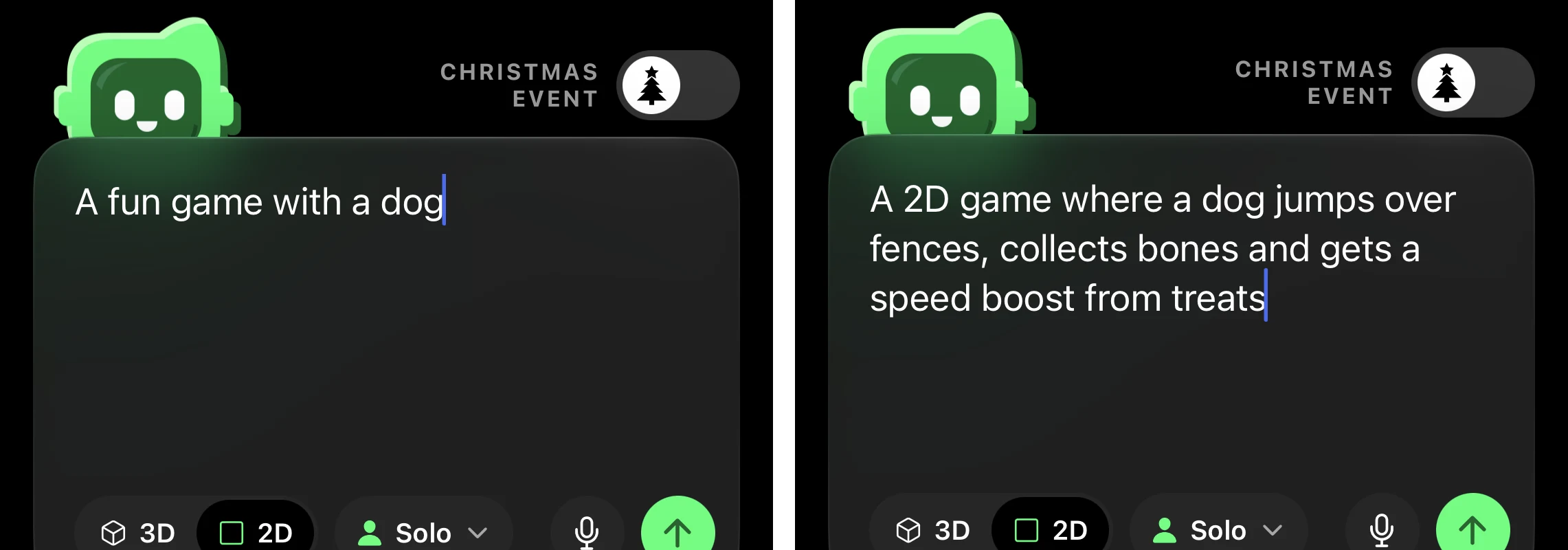
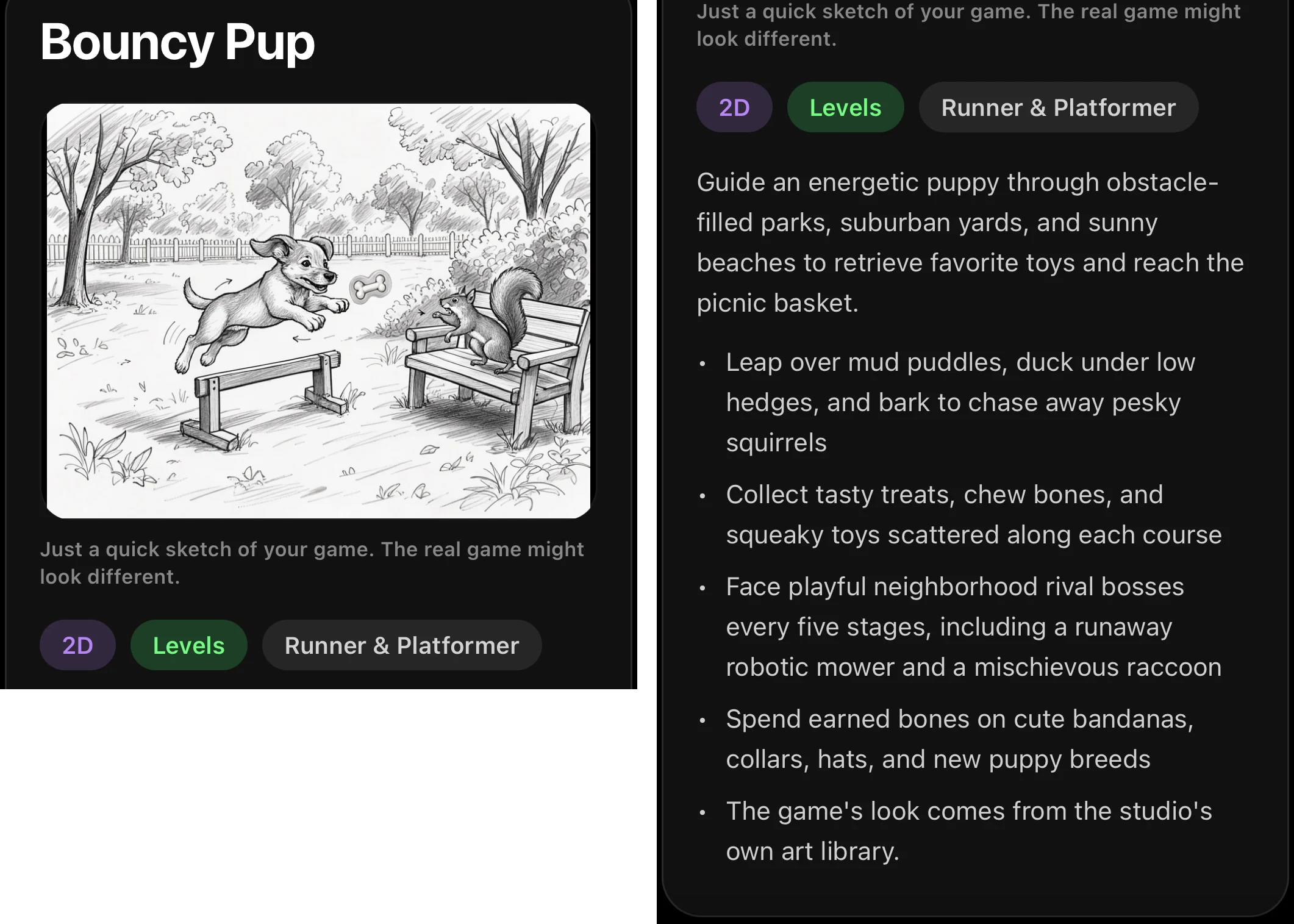
The vague prompt: "A fun game with a dog" ✅
Flikk still made a full plan: Bouncy Pup, a Runner & Platformer. But Flikk picked all the mechanics: leap over mud puddles, duck under hedges, bark to chase away squirrels, collect treats and toys, neighborhood bosses every five stages, and bones to spend on bandanas, collars, hats and new puppy breeds.
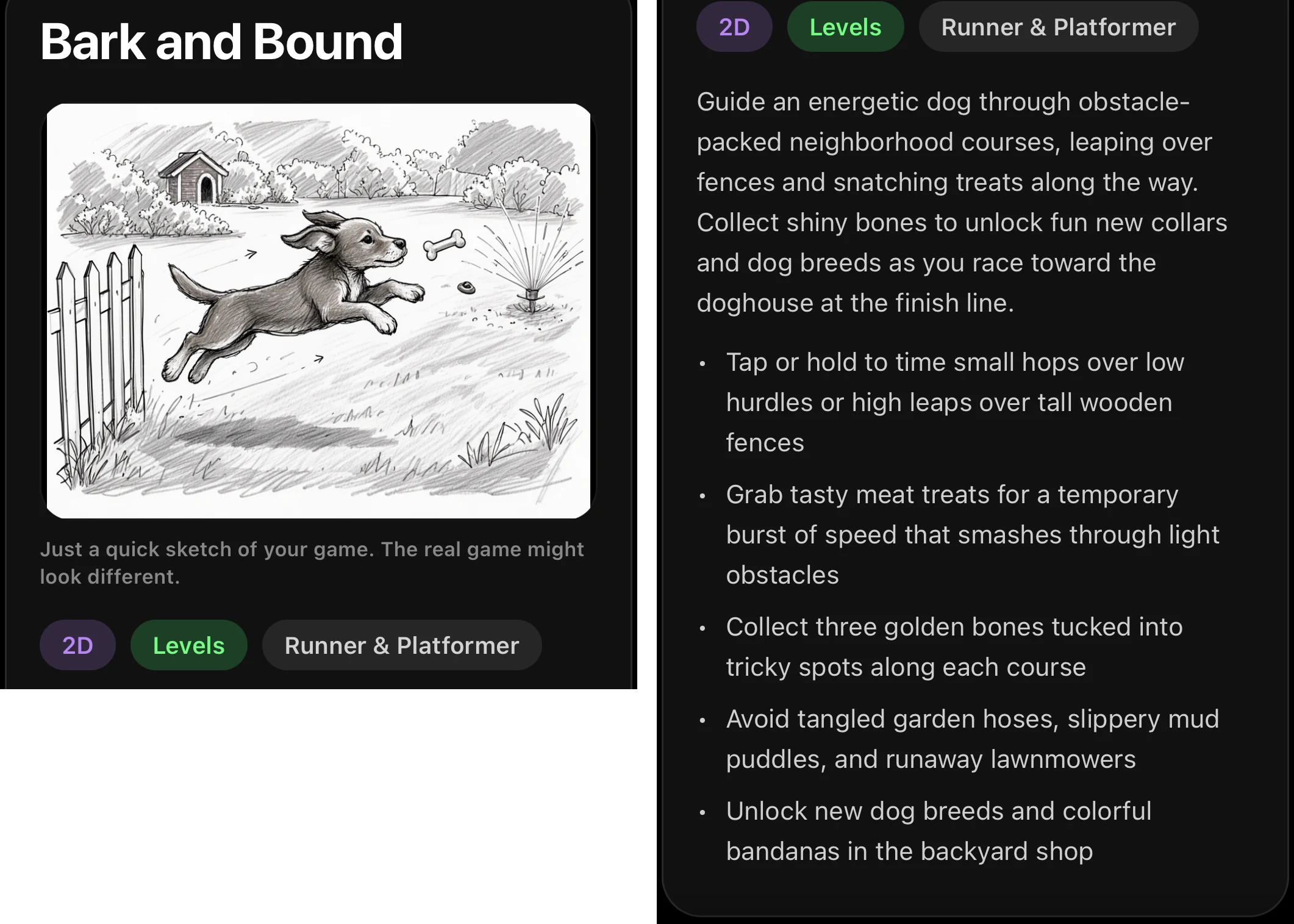
The prompt with mechanics: jump, collect, speed boost ✅
This one became Bark and Bound, also a Runner & Platformer. Every mechanic we named is in the plan:
| We asked for | The plan says |
|---|---|
| Jumps over fences | "Tap or hold to time small hops over low hurdles or high leaps over tall wooden fences" |
| Collects bones | "Collect three golden bones tucked into tricky spots along each course" |
| Speed boost from treats | "Grab tasty meat treats for a temporary burst of speed that smashes through light obstacles" |
Flikk also added dodging (garden hoses, mud puddles and lawnmowers) and unlocks (new dog breeds and bandanas in the backyard shop).
What we learned
- A vague prompt still works. Flikk fills in the mechanics for you, which is great if you just want to see an idea.
- Naming mechanics gives you control. Both plans are runners, but only the second one has exactly the jumping, collecting and speed boost we wanted.
- Flikk adds extras either way. Both plans got unlocks, and the vague one even got bosses. If you don't want something, tap Edit before you build.
- Check the free plan first. Building costs 100 Tokens and takes about 15 minutes, but the plan is free, so try a few prompts until it says what you want.
More tips: how to write a game prompt that works.
FAQ
What are game mechanics?
Game mechanics are the actions players can take and the rules that respond to them, like jumping, shooting, matching, collecting or upgrading. They decide how a game plays, while the theme decides how it looks.
What are examples of game mechanics?
Common game mechanics are jumping, auto-running, steering, dodging, aiming and shooting, timing, drag and drop, swiping, matching, merging, stacking, sorting, collecting, upgrading, idle income, crafting, health and lives, timers, waves and power-ups.
What is the difference between game mechanics and gameplay?
Mechanics are the single parts, like jumping or collecting. Gameplay is what it feels like when all the mechanics work together while someone plays.
What is a core mechanic?
The core mechanic is the main action a player repeats the most, like jumping in a platformer or merging in a merge game. If the core mechanic isn't fun, the rest of the game can't fix it.
How many mechanics should a game have?
Most good games have two to four. For a first game, start with one core mechanic and add more once it feels good.
What are the best game mechanics for mobile games?
Mechanics that work with one thumb: tapping, timing, swiping, drag and drop, merging and auto-running. See our guide to mobile game controls.
What happens if I don't name any mechanics in my prompt?
On Flikk, you still get a full game plan, but Flikk picks the mechanics for you. In our test, "A fun game with a dog" became a runner where the puppy leaps, ducks, barks at squirrels and fights bosses. Name the mechanics if you want a specific game.
Can I make a game with these mechanics without coding?
Yes. On Flikk, you describe your game in a sentence or two, name the mechanics you want, check the free game plan and build it in about 15 minutes. No code needed.