The Most Important Part of Game Design (and How to Test It on Your Phone)
The core loop is the most important part of game design. Learn its 3 parts, then make a game and improve its loop in 3 edits on Flikk.
In this article
- What is a core loop in game design?
- Step 1: Make a starter game in one sentence
- Step 2: Run the 30-second test
- Step 3: Edit 1, give the player a clear goal
- Step 4: Edit 2, add meaningful choices and skill
- Step 5: Edit 3, make the feedback feel good
- Before and after: what three edits did to the loop
- How to get better at game design
- Try it now
- FAQ
The most important part of game design is the core loop: the small thing a player does again and again, and whether it feels good to repeat. Get the loop right and a game can be tiny, ugly and plotless and still keep people playing. Get it wrong and no amount of story, art or extra levels will save it.
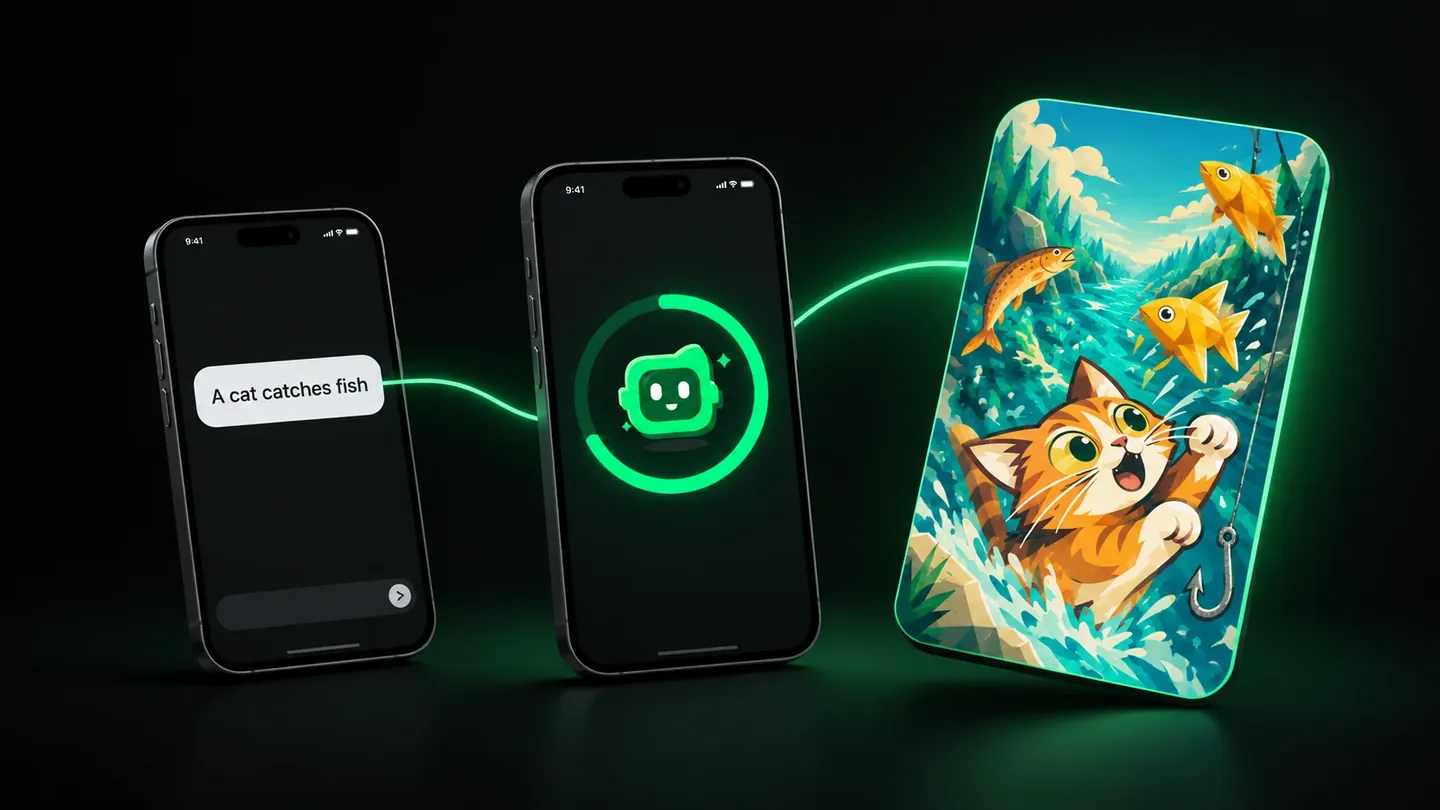
You can read about core loops all day. It's faster to build one. So in this guide I made a game from one sentence on Flikk, then improved its loop step by step with three edits, one for each part of a good loop. You can follow along on your phone while you read.
Quick note: I'm on the Flikk team, and Flikk is our app. Every screenshot, prompt and score below is from my real build on October 6, 2026.
Get Flikk on iOS or Android if you want to build along.
What is a core loop in game design?
A core loop is the cycle at the center of every game: act, get feedback, want to act again.
- In Tetris, you place a block, a line clears, and the next block is already falling.
- In Flappy Bird, you tap, you squeeze through a gap (or you don't), and you tap again.
- In Wordle, you guess, the tiles change color, and you guess again with more information.
Everything else in a game sits on top of that loop: story, graphics, sound, levels, unlocks. If the loop is satisfying, all of that makes it better. If the loop isn't, all of that is decoration on something nobody wants to repeat.
A good core loop has three parts:
- A clear goal. Within seconds, the player knows what they're trying to do.
- Meaningful choices or skill. What the player does changes the outcome, so winning feels earned.
- Instant, satisfying feedback. Every action gets a response the player can see, hear or feel. Designers call this "game feel" or "juice", and it's often the difference between "meh" and "one more try".
Here's a quick test for any game, including yours: strip away everything except the basic action. Is it still fun for 30 seconds? If yes, you have a game. If no, adding content won't fix it.
Step 1: Make a starter game in one sentence
Open the Create tab in Flikk and describe a game. The app says one or two sentences is enough: "Say what the player does and the studio fills in the rest." I kept it as short as possible:
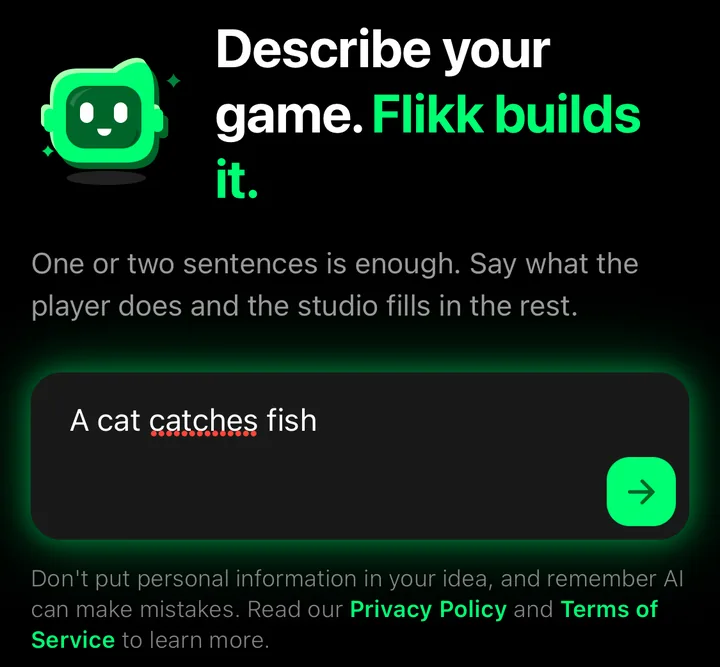
Before building anything, Flikk turned my four words into a game plan: a cat that slides along the bottom of a river, fish and hooks falling from above, three lives, and a "frenzy" mode that doubles points. You can change the plan with Edit or approve it with Build it.
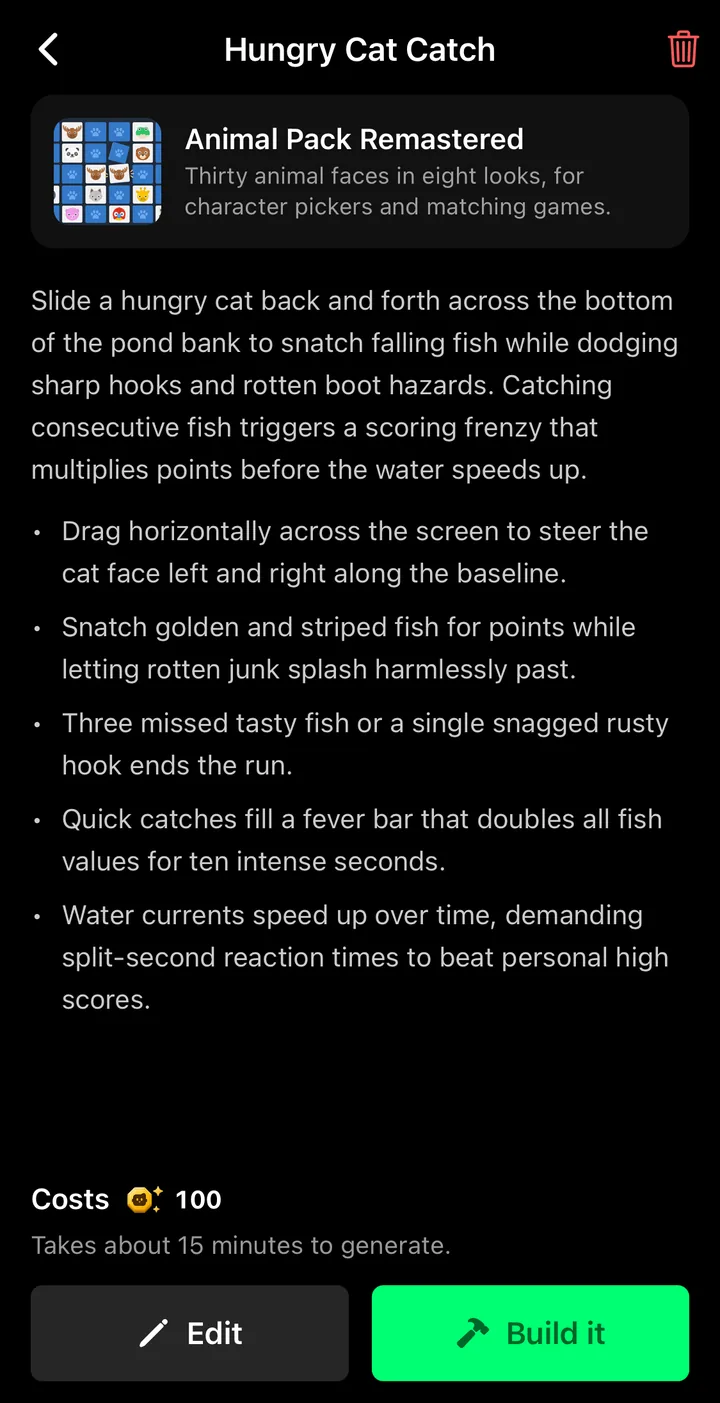
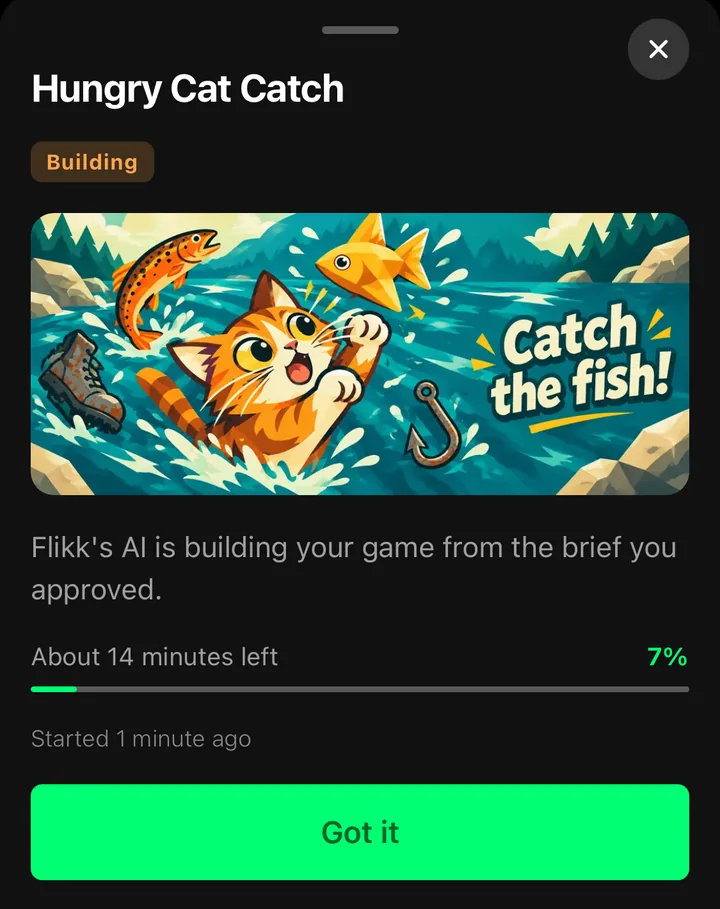
Then it builds, inside the app, in about 15 minutes. Mine was ready in about 10.
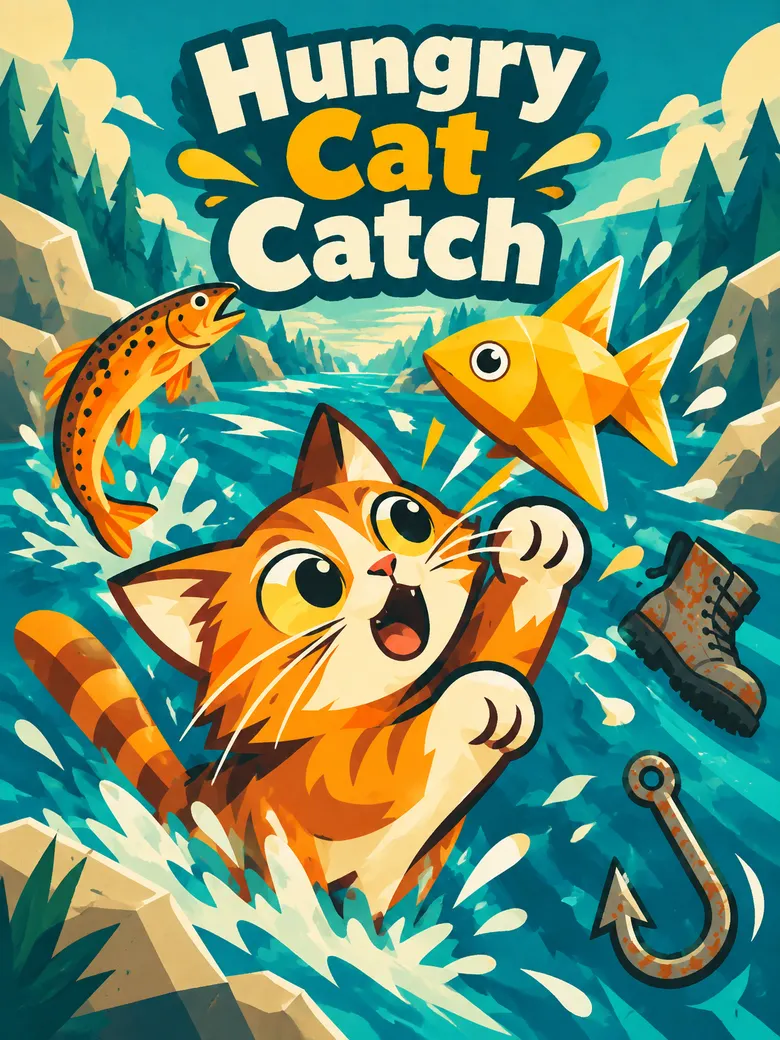
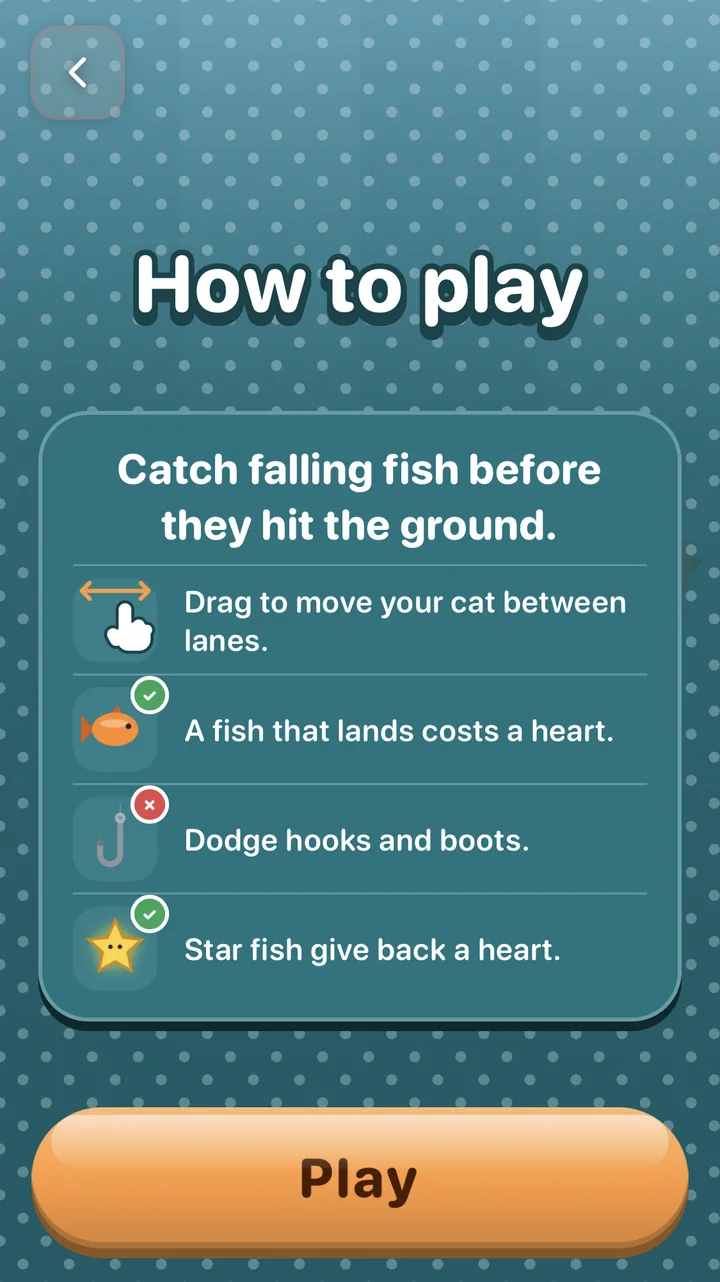
The finished game is called Hungry Cat Catch. It even came with a "How to play" screen:
Try it yourself: type your own one-sentence idea in the Create tab. Keep it simple, with one character and one action. You'll improve it in the next steps.
Step 2: Run the 30-second test
Play your game for 30 seconds and name its loop in one line. Mine was:
Slide between lanes, catch falling fish, dodge hooks. Catch 5 fish in a row and frenzy starts: everything turns into golden fish worth double points.
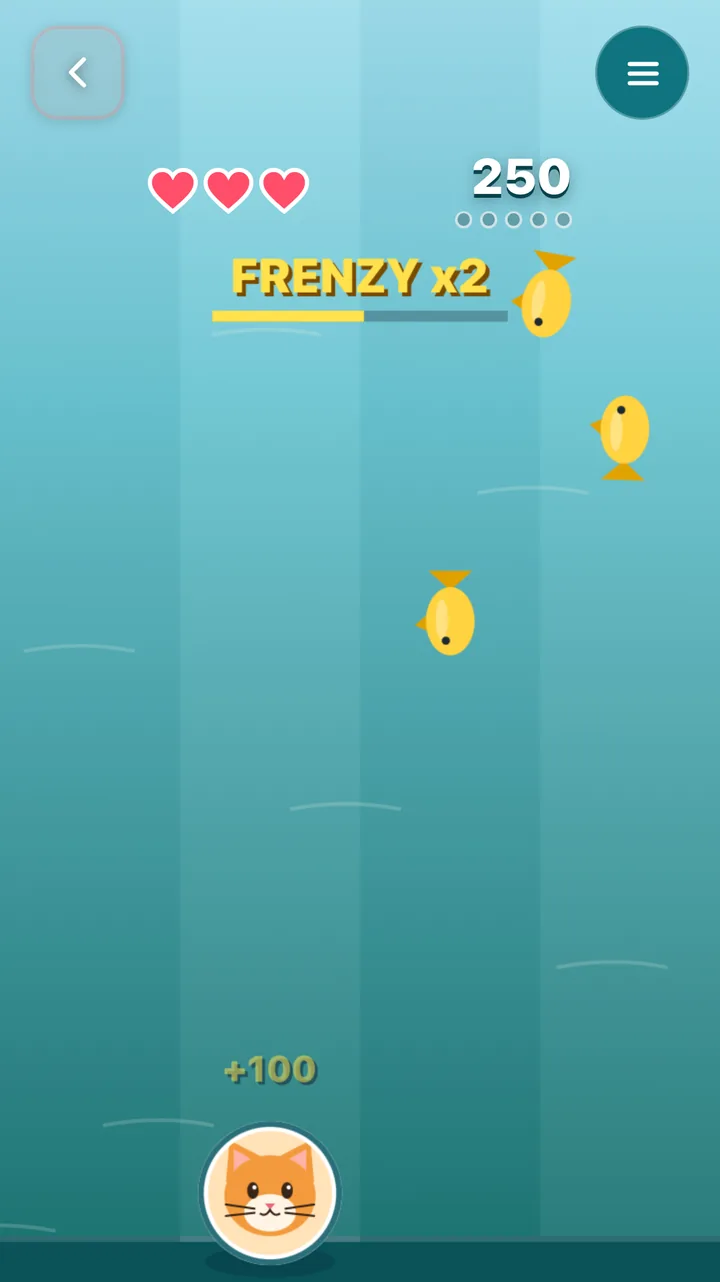
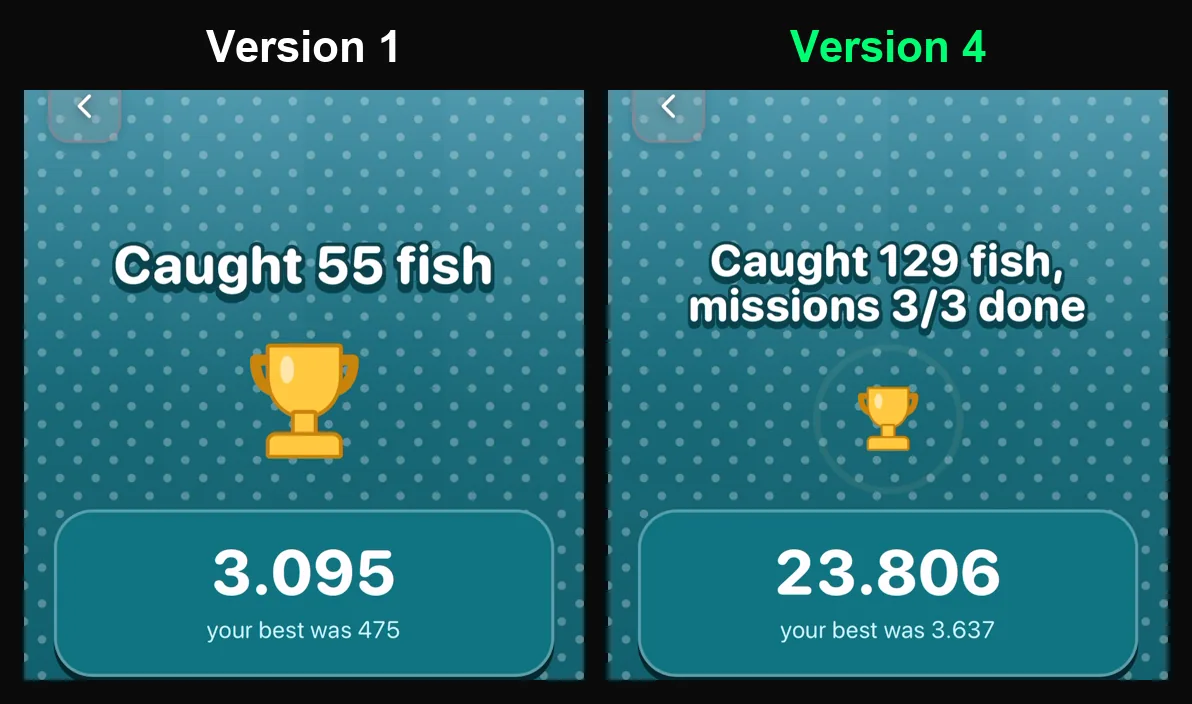
And honestly? It passed. Catching fish felt fine and the frenzy was a nice burst. My first run ended with 55 fish and 3,095 points.
But after a few runs it got stale. There was nothing to aim for except "don't die", every fish was the same decision (catch it), and catching one didn't feel like much.
That's the real lesson of this article: even a good first version has gaps in its loop. The three parts of a core loop are a checklist for finding them. I fixed one gap per edit.
Step 3: Edit 1, give the player a clear goal
The design idea: "survive as long as you can" is a goal, but a vague one. Players stay longer when they always have a target that's a few seconds or a few fish away.
On your game's page, open the Make Edits tab and describe the change. I typed:
Give every run 3 small missions shown at the start, like "catch 5 golden fish in one frenzy" or "dodge 10 hooks" that reward coins, and show a "Best" line on screen that the player can see coming and pass.
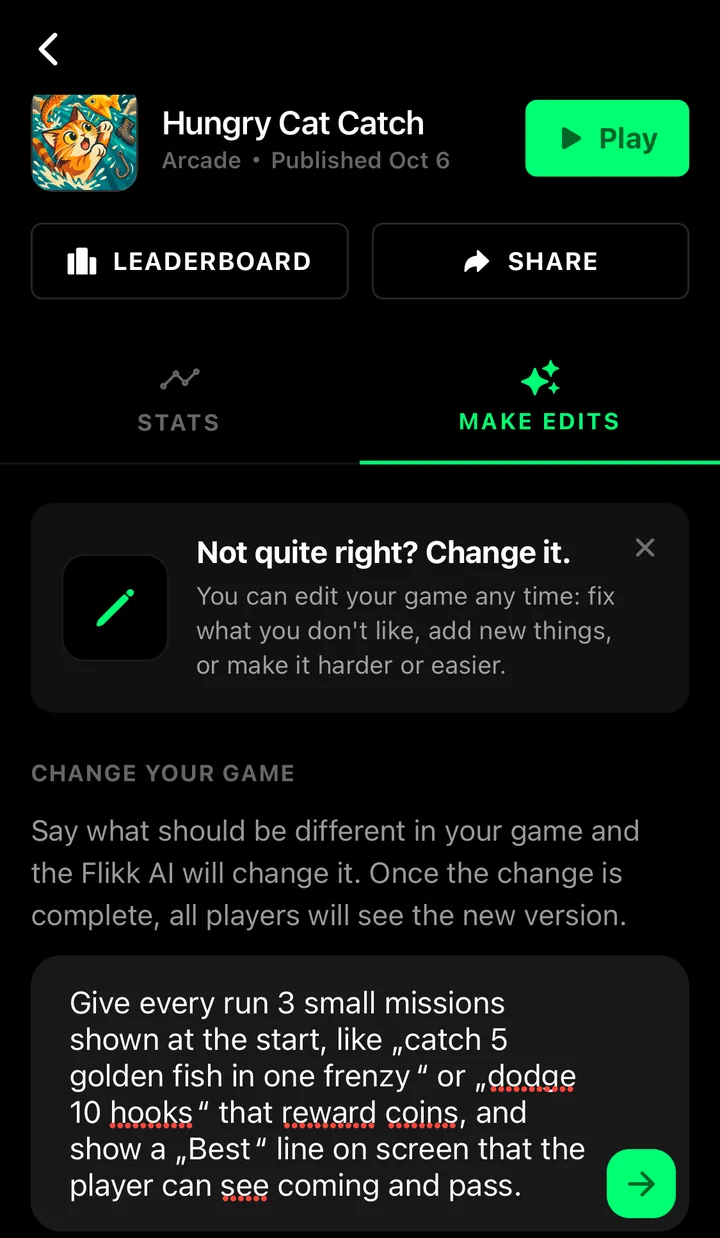
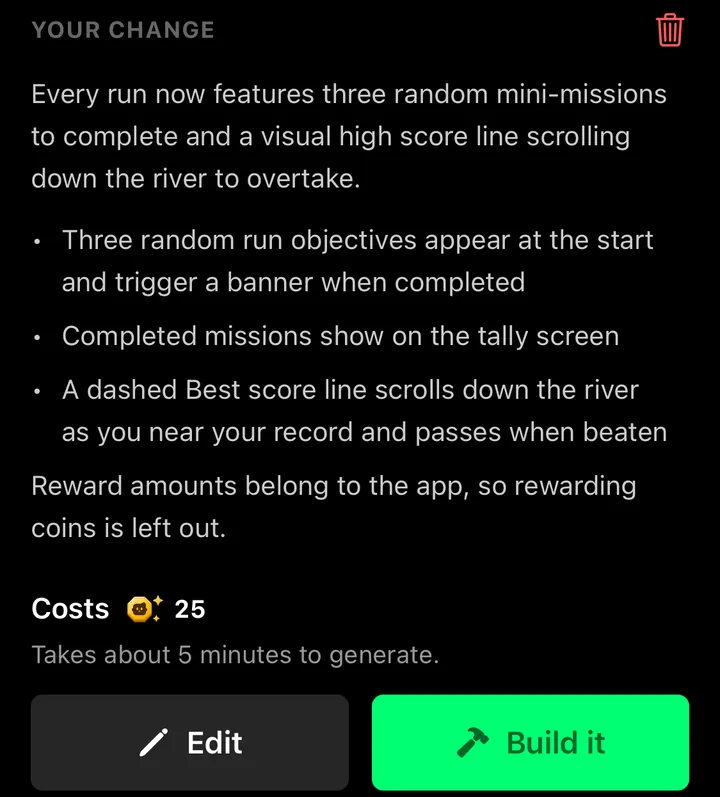
Like the first build, Flikk shows a plan before it changes anything. It took the missions and the Best line, and left the coins out: "Reward amounts belong to the app, so rewarding coins is left out." An edit takes about 5 minutes, and players keep the old version until the new one is done.
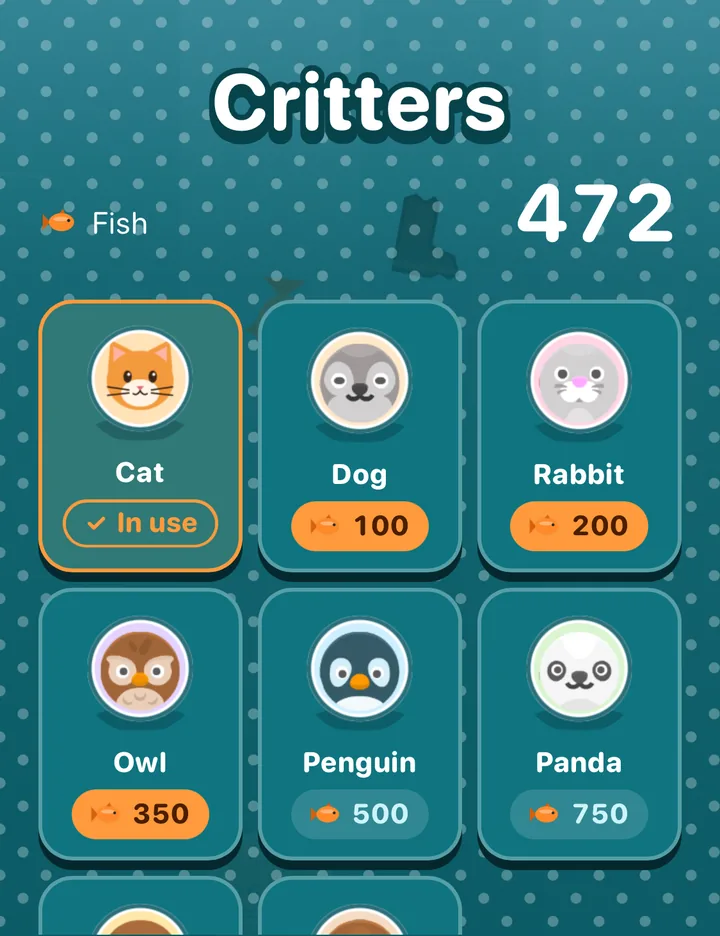
Later I realized I didn't need coins at all. My game already had a currency from version 1: the fish you catch. You spend them in the Critters shop to swap the cat for a dog, a rabbit, an owl and more. Lesson: before you ask for something new, check what your game already has.
What changed: the loop itself felt the same, but now every run started with three missions, and a dashed "BEST" line scrolled down the river toward me as I got close to my record.
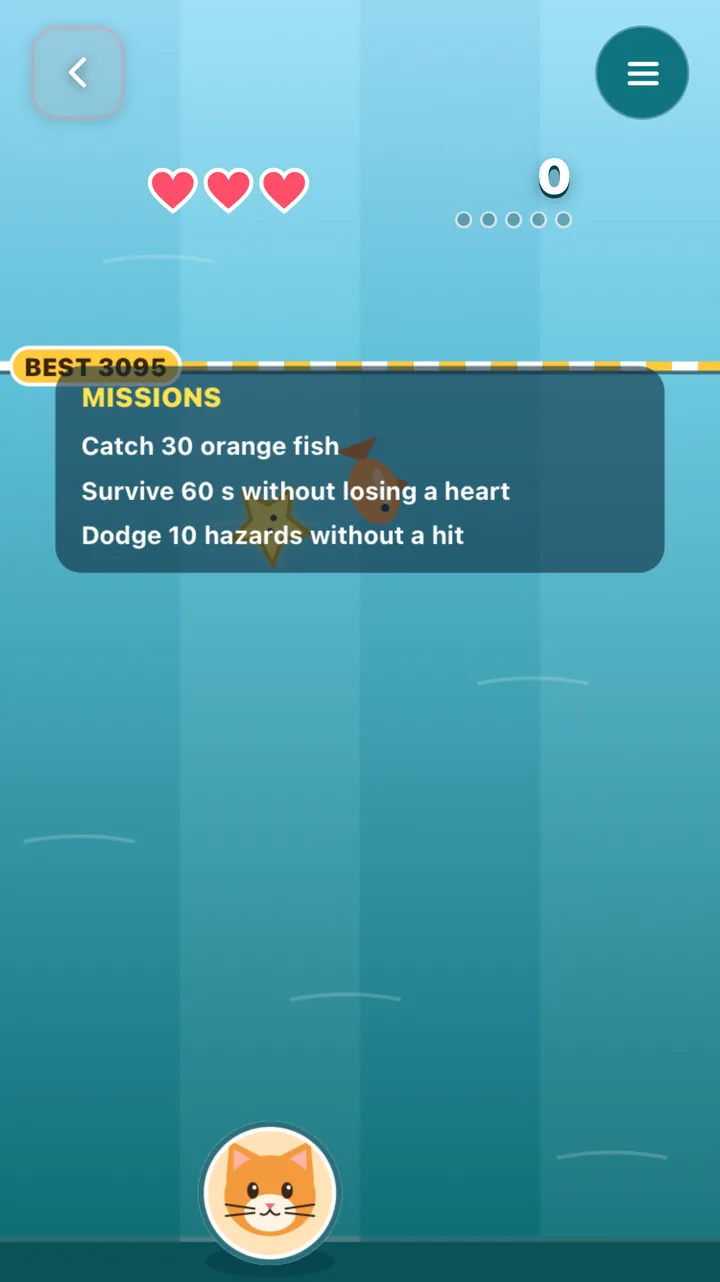
I played longer per run, because I wanted to pass that line or finish one more mission. Same action, clearer reasons to keep doing it.
Step 4: Edit 2, add meaningful choices and skill
The design idea: in version 1 there was one right move: catch everything. A loop gets deeper when the player has to weigh options, like risk against reward, or now against later.
My second edit:
Missing a fish no longer costs a life. Instead, a hunger meter slowly drains and every fish refills it, if it empties the run ends. Missing a fish also resets a combo multiplier that grows with every catch. Golden fish sometimes appear right next to hooks and the frenzy meter is saved until the player taps a button to activate it. The game speeds up slowly over time.
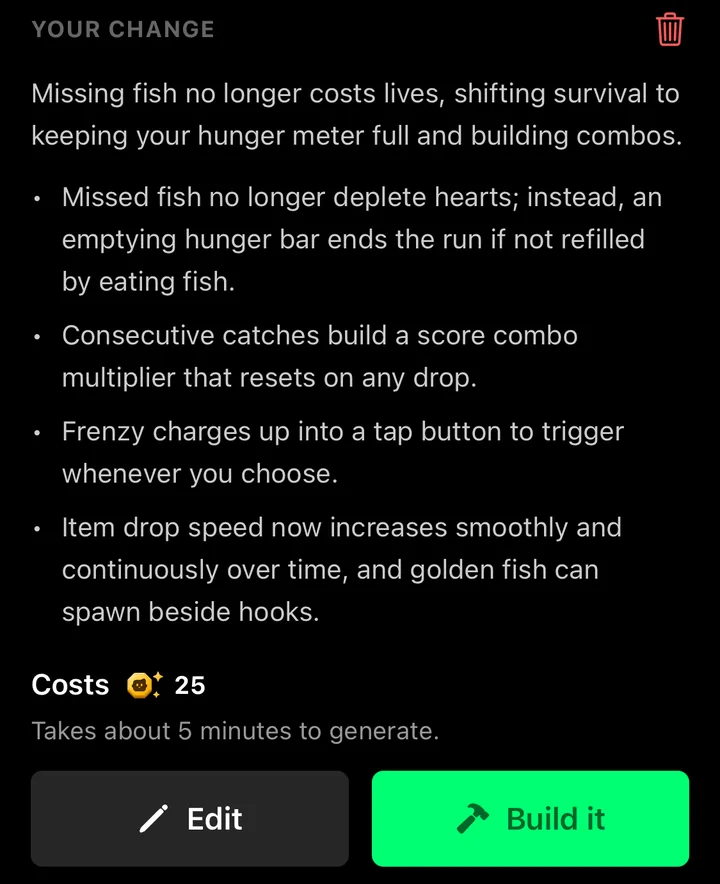
That one edit turns "catch everything" into real decisions:
- Do I risk the hook for the golden fish?
- Do I protect my combo, or let a fish go to stay safe?
- When do I use my frenzy?
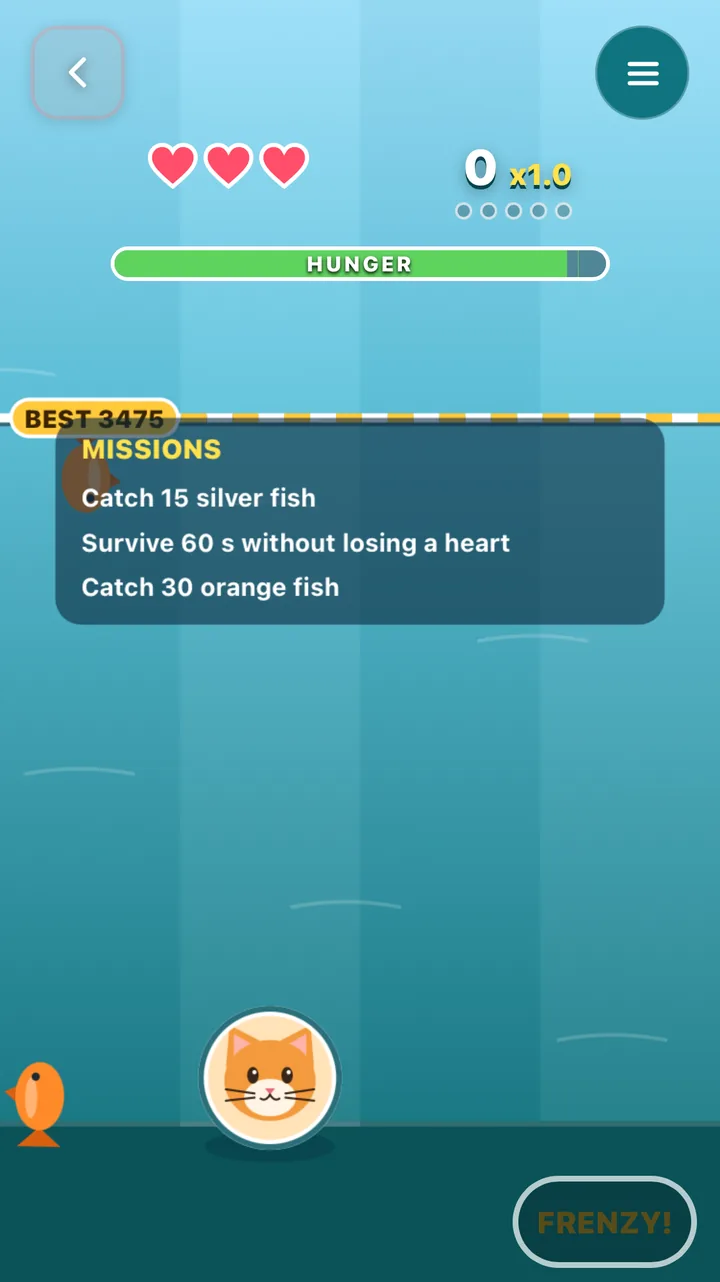
What changed: it stopped feeling like an endless runner with no goals and started feeling like a game. The hunger meter gives the loop a reason to exist: you catch fish because the cat is hungry, not just for points.
The honest part: it still wasn't hard enough for me. That's a difficulty question (speed, how often hooks appear), and it's normal to leave tuning like that for later, once the loop works.
Step 5: Edit 3, make the feedback feel good
The design idea: feedback is how the game answers the player. A catch that makes a sound, a pop and a bigger number feels like an achievement. The same catch in silence feels like nothing. This step doesn't change the rules at all, only how they feel.
My third edit:
When catching a fish, show a pop, a floating "+1" and a combo meter that grows bigger and brighter. A close dodge past a hook flashes and slows time for a moment. Losing a life cracks a heart icon with a red flash and short screen shake. Frenzy starts with a gold flash and faster music, and passing your best score shows "NEW BEST!" mid run. Add phone vibration on catches and hits.
At the very end I also added "Add coins to collect". Flikk left it out again ("Coin rewards belong to the app rather than the game, so coins are left out."), which was fine: the fish already do that job.
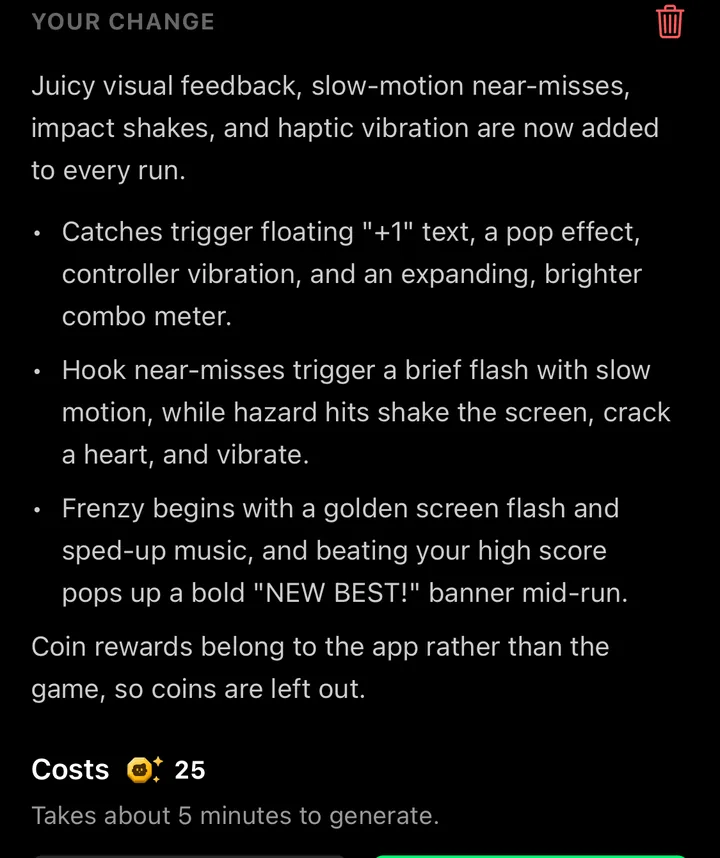
What changed: the gameplay was identical, but it felt like an arcade game now. Every catch pops, the combo grows, hits shake the screen, and passing my old record throws a big banner across the river:
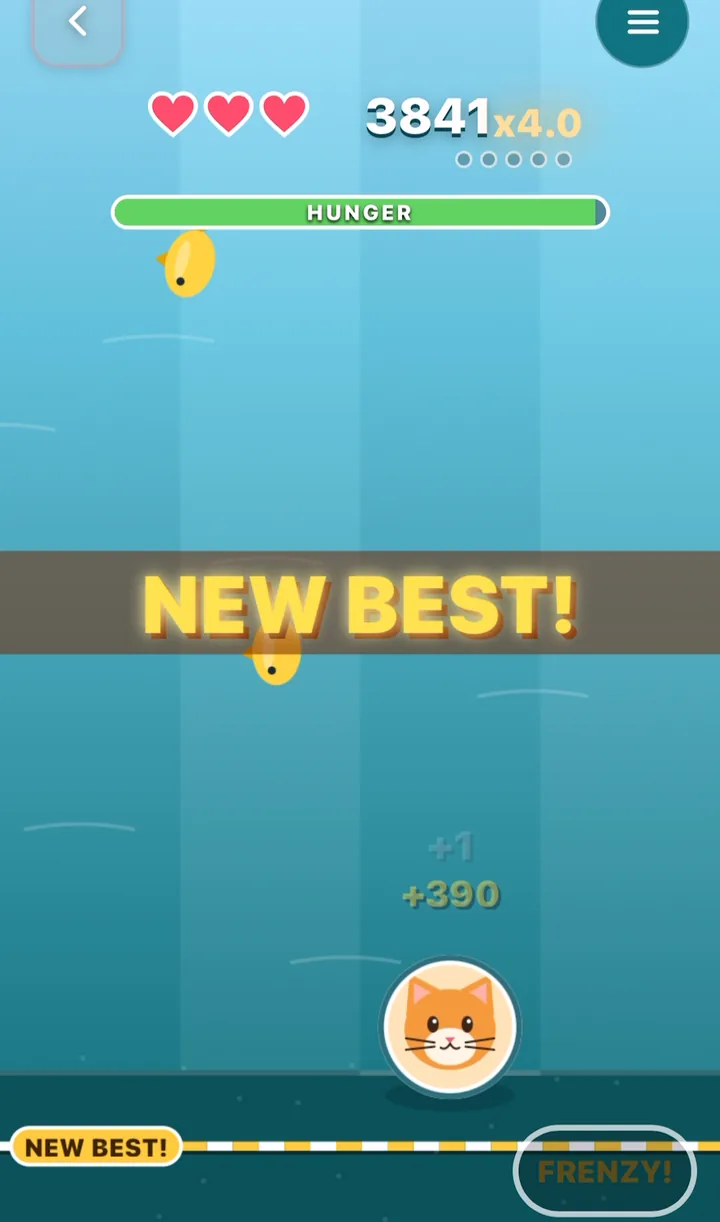
That banner is a tiny thing, and it made me want to keep going. Once I'd beaten my best, I kept playing to finish the missions.
Before and after: what three edits did to the loop
Here are the end screens of a run on version 1 and a run on version 4:
| Version 1 | Version 4 | |
|---|---|---|
| Fish caught | 55 | 129 |
| Score | 3,095 | 23,806 |
| Missions | none | 3 of 3 done |
| Run length (from my recordings) | about 1 minute 15 | about 2 minutes 20 |
My own runs on October 6, 2026. The score jump is partly the new combo multiplier, so compare fish caught and run length, not just points.
The core loop never changed: slide, catch, dodge. Each edit just made it more complete. Edit 1 gave it a target, edit 2 gave it decisions, and edit 3 made every action feel like it counted.
That's also why this order matters. If the loop hadn't been fun to begin with, the shiny feedback in edit 3 wouldn't have saved it. Polish makes a good loop great. It can't make a bad loop good.
How to get better at game design
The fastest way to get better at game design is to make a lot of small games and change one thing at a time. That used to take weeks per idea. On Flikk it's a sentence and about 15 minutes, and each edit takes about 5.
A practice routine that works:
- Make something small. One character, one action.
- Run the 30-second test. Name the loop in one line.
- Fix one part of the loop per edit: goal, then choices, then feedback.
- Play each version yourself. Write down what felt better and what didn't.
- Send it to a friend and see if they can beat your score. If they ask for "one more try", your loop works.
Then tune it: try different speeds and difficulties, new fish or hook types, until the game feels right to you. You can also remix any game someone else made on Flikk. That's a great way to study a loop you like and try it your own way.
Try it now
You don't need code, an engine or a computer. Open the Create tab in Flikk, describe your game in one sentence, and give its loop three edits. You can also play the final version of my game: search for Hungry Cat Catch in the app.
Download Flikk on iOS · Download Flikk on Android
FAQ
What is the most important part of game design?
The core loop: the main action a player repeats, and whether it feels good to repeat. It needs a clear goal, meaningful choices or skill, and instant feedback. Everything else in a game builds on it.
What is the first rule of game design?
There's no single official rule, but a common answer is "make the core action fun first." If your basic action isn't fun for 30 seconds, adding levels, story or graphics won't fix it.
Can AI help you design games?
AI can build a game from a description and change it when you describe edits, which makes testing design ideas much faster. You still make the design calls: what the goal is, which choices matter, and what feels good. On Flikk, it also turns your idea into a plan you approve before anything is built.
Is Flikk free?
Flikk is free on iOS and Android, and making games is free to start. Optional in-app purchases let you make more games or edit the ones you made. As of October 6, 2026, a new game cost me 100 Tokens and each edit cost 25 Tokens. Flikk is available in the US.
Can I edit a game after I made it?
Yes. Open your game's page and use the Make Edits tab to describe what should change. Flikk shows you the change before building it, and once it's done, everyone who plays your game gets the new version.