Someone Already Made That Game? Make Your Own Version Anyway
The game you want to make probably exists already. Make it anyway. Here's why your version will never be the same game, and a 5-step exercise that turns remaking into real game design practice.
In this article
You have an idea for a game. Then you remember: that already exists. Someone made it, maybe years ago, maybe last week on Flikk. So you don't start.
That's one of the most common reasons people never make their first game. And it's the wrong reason.
What game designers say about it
Last week, we sat in a game design talk with experienced designers from a mobile games studio, the kind that makes big mobile games played by millions. Someone asked about making a game that already exists. Their answer was clear: make it anyway.
Their reasoning went like this:
- It won't be the same game. Even if you try to make the exact same game, it gets a different direction and a different feel, because you made it. Your vision isn't the original maker's vision.
- It's not a rip-off. It's a new version. It's that game the way you would have made it.
- You fix what bothered you. Every game has things you'd change. Now you can.
- You add what you always wanted. The feature you wished was there? Put it in.
- You get better. Every version you make teaches you something about game design.
In the end, you haven't made the same game. You've made another game.
Same start, five different games
We've seen this ourselves. On this blog, we started with the same thing five times: a plain match-3 game. Same idea, same kind of board. Then we asked one question each time: what if every match did something?
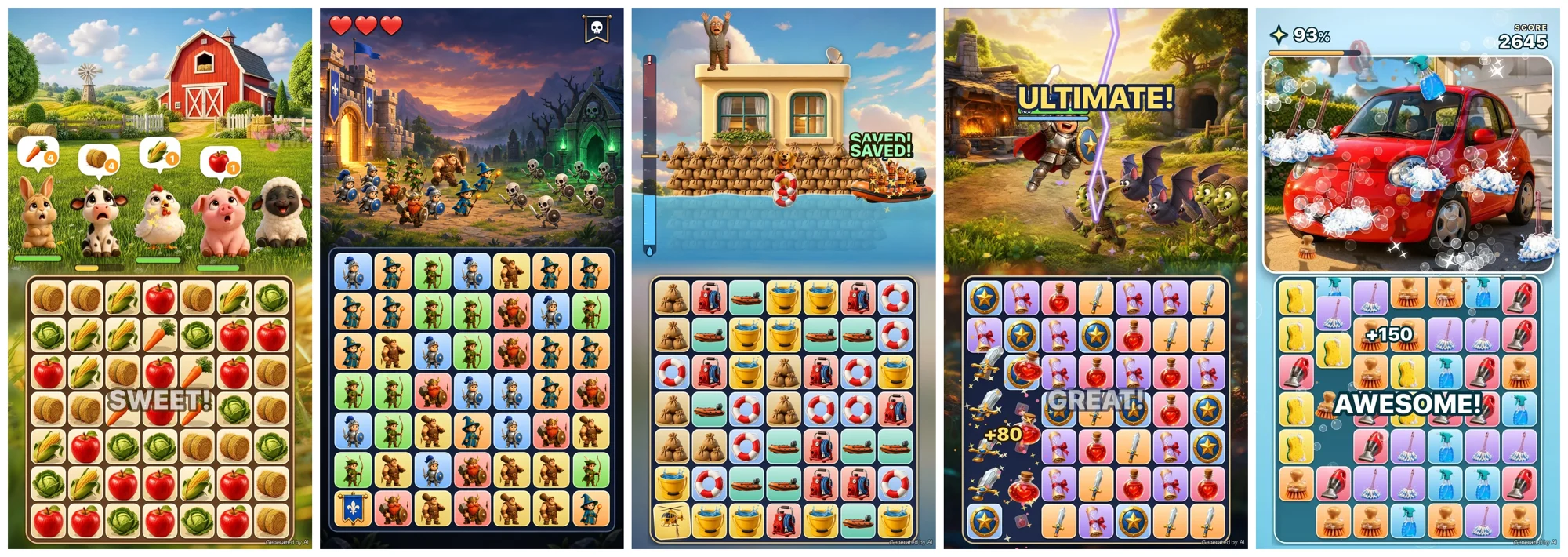
We got five completely different games:
- A farm where your matches feed hungry animals.
- A battlefield where your matches send troops against skeleton hordes.
- A rooftop where your matches save people from a flood.
- A hero in a storm who fights with the items you match.
- A dirty car that your matches scrub clean.
Same board, same rule. Five ideas, five feelings: cozy, epic, tense, heroic, satisfying. That's what happens when a different vision touches the same idea.
Every game type started this way
Think about any game type you know: match-3, racing, bullet hell, tower defense. None of them is one game. Each is hundreds of games, made by people who played one, loved it and thought: I'd do it a bit differently.
That's how game types grow. Someone's version adds a new rule, and the next person builds on that. When you make your version, you're doing exactly what game designers have always done.
The remake exercise: 5 steps
Here's a simple exercise that turns "I want to make that game too" into real game design practice. You only need a game you like and your phone.
Step 1: Pick a game you've played a lot
On Flikk or anywhere else. It works best with a game you know really well, because you already have opinions about it.
Step 2: Describe it in one sentence
What do you actually do in it, over and over? That's the core loop. Write it down without the game's name.
For Arrow Outbreak, a puzzle game made by the Flikk team, it would be: "You tap tangled arrows, and each one flies off the board if nothing blocks its way."
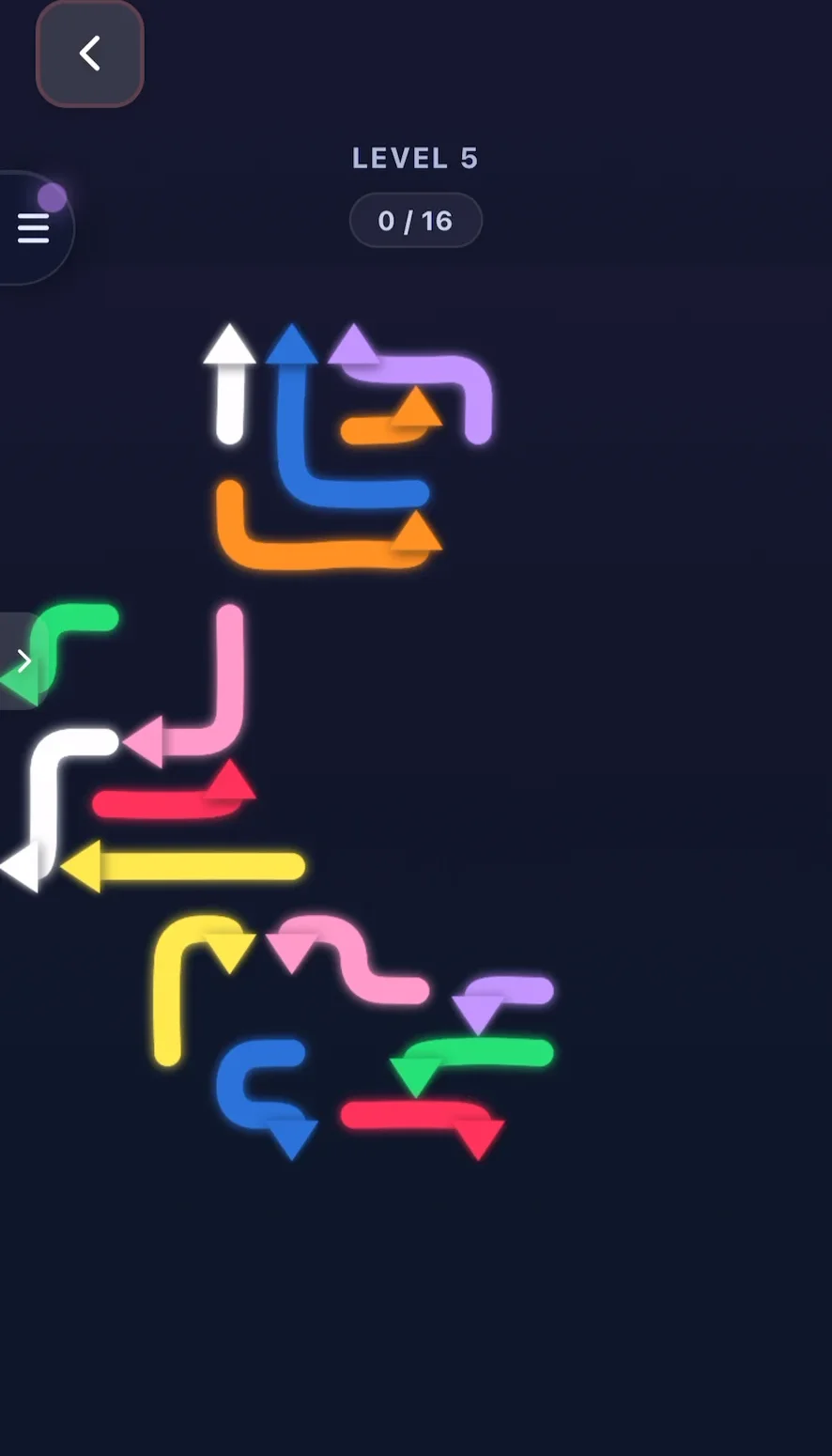
Step 3: Write down what you love, and what bothers you
Make two short lists. Be honest. For Arrow Outbreak, it could look like this:
| What I love | What bothers me |
|---|---|
| Levels take about a minute | One wrong tap restarts the whole level |
| The knot slowly comes apart | The board always looks the same |
| Easy to understand | I want a reason to go faster |
Your lists will look different from someone else's. That's the point. These lists are your vision.
Step 4: Write your prompt
Now write the prompt for your version. Use your one sentence from step 2, then add your fixes, one new feature and your own setting. A simple pattern:
"A [type of game] where [what you do]. [Your fix]. [Your new feature]. Set it in [your world]."
For our Arrow Outbreak example:
"A puzzle game where colorful fish are tangled in a net, and each fish swims away when tapped if nothing blocks its way. A wrong tap costs one of three hearts instead of restarting the level. Clearing a level fast gives a gold star. Set it in a bright coral reef."
Look at what happened. Same core idea, but now it's underwater, it's more forgiving, and it rewards speed. That's a different game.
Open the Create tab and send it. Getting a game plan is free. If you like it, tap Build it (100 Tokens), and it's ready in about 15 minutes.
Step 5: Play it, compare it, change one thing
Play your version, then play the original again. Ask yourself:
- What feels different? Why?
- Did my fix actually make it better, or did it break something?
- What would I change next?
Then open Make Edits and change one thing (25 Tokens, about 5 minutes per edit). This is where the real learning happens: you start to see why the original maker made the choices they made.
Why remaking makes you a better game designer
- You see the hidden decisions. Playing a game, everything feels obvious. Making it, you notice the hundreds of choices behind it: how fast, how hard, how big.
- You find out what's hard. Maybe the thing that bothered you was there for a reason. That's a lesson too.
- You build your own taste. After a few remakes, you know what you like in a game. That's what turns you into a designer with your own style.
- You finish games. Starting from something you know is easier than starting from nothing. And finished games teach you more than ideas in your head.
Make it yours: three rules
Making your own version is great. Copying someone else's work isn't. The difference:
- Take the idea, not the stuff. Game ideas and rules are free for everyone to build on. Names, characters, logos and art belong to the people who made them. Give your game its own name and its own world.
- Change at least three things. A fix, a new feature and a new setting. That's the minimum for a version that's really yours.
- Give credit. If another creator's game inspired yours, say so. Creators love seeing what their game inspired, and it's a nice way to say thank you.
Ideas to start with
Not sure which game to remake? Our posts are full of games and prompts you can use as a starting point:
- 15 easy game ideas for beginners, each with a prompt
- How to make a bullet hell game from a six-word prompt
- How to write a game prompt that gets you the game you imagine
Take one, run it through the five steps, and make it yours.
FAQ
Is it okay to make a game that already exists?
Yes. Most games are new versions of game types that already exist. As long as you make your own version, with your own name, characters and art, you're doing what game designers have always done.
Is it okay to copy a game?
Copying a game's name, characters, art or logo isn't okay: those belong to their makers. Making your own game with a similar idea and your own changes is how new games are made.
How do I make my version different from the original?
Write down what bothers you about the original and fix it, add one feature you always wanted, and set it in your own world. Those three changes alone make it a different game.
How do I get better at game design?
Make games, a lot of them. Remaking games you like is one of the best exercises, because you compare your choices with the original and learn why things work.
Can I remake a game on Flikk without coding?
Yes. Describe your version in the Create tab, in your own words, and Flikk builds it in about 15 minutes. Then use Make Edits to change one thing at a time.