Exams Coming Up? Make Your Own Study Game in About 15 Minutes
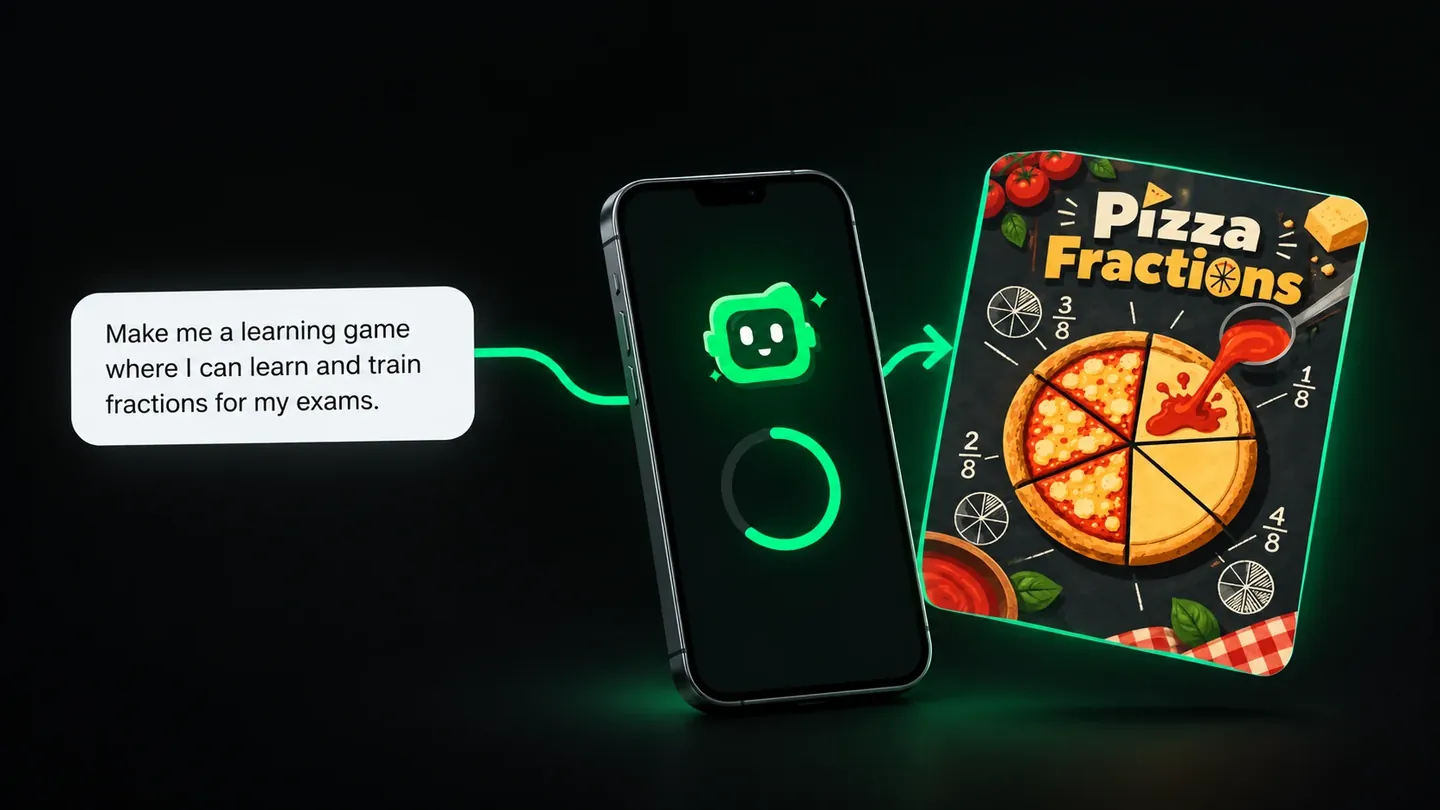
Stuck on a school topic? Describe a study game for exactly that topic and Flikk builds it in about 15 minutes. Here's how I made one for fractions.
In this article
Exams are coming, and there's that one topic that just won't click. You can read the chapter a fifth time, or you can turn it into a game. On Flikk, you describe a study game for exactly the topic you're stuck on, and it's built on your phone in about 15 minutes. No code, no teacher's worksheet, no generic quiz app.
I tried it with a topic that trips up a lot of people: fractions. Below is the whole build, from the sentence I typed to the game I played, plus ideas for turning your own hard topics into games.
Quick note: I'm on the Flikk team, and Flikk is our app. Every screenshot and prompt below is from my real build on October 8, 2026.
Why some topics just don't stick
Some school topics are easy to memorize and hard to get. You can repeat the rule, but you can't see why it's true, so it falls out of your head right after the test.
Fractions are a classic example. When I was in school, a friend of mine was sure that 1/4 is bigger than 1/2. It makes sense if you think like a whole number: 4 is bigger than 2, so 1/4 must be bigger too. It's wrong, and he's far from the only one.
Researchers at the University of Cambridge describe exactly this mistake. They call it whole number bias: kids use what they know about whole numbers on fractions, where it doesn't work. A fraction also has two numbers that only mean something together, which whole numbers never do. In a 2013 study they cite (Gabriel, Szűcs and Content, PLOS ONE), "most of the primary level pupils in our study had only a very limited understanding of fractions."
The part I found most interesting: the kids in that study talked about pieces of pie or pizza, but they "did not really understand which local value of the fractions correlated with the pieces of the pie or pizza and which correlated with the whole." So the pizza picture alone isn't enough. You have to connect the number to the slices yourself, again and again, until it sticks.
That's something a game is good at.
Why a game you make yourself helps
A game gives you what a textbook can't:
- You do something. You don't read about 3/8, you fill 3 of 8 slices yourself.
- You see right away if you were right. No waiting for a corrected test.
- You repeat it without it feeling like homework. One more level is easier to start than one more page.
And when you make the game yourself, it's about your topic, at your level, in the style you like. Pizza, beans, cards, planets, whatever makes sense to you. I'm a visual learner, so I wanted to see the fractions, not just read them.
Flikk is an app where you make games with AI. Most people make arcade and puzzle games with it, but nothing says your game has to be about jumping or shooting. It can be about fractions.
How I made a fractions game in about 15 minutes
Step 1: Describe the game you want to learn with
I opened the Create tab and typed what I needed, in plain words:
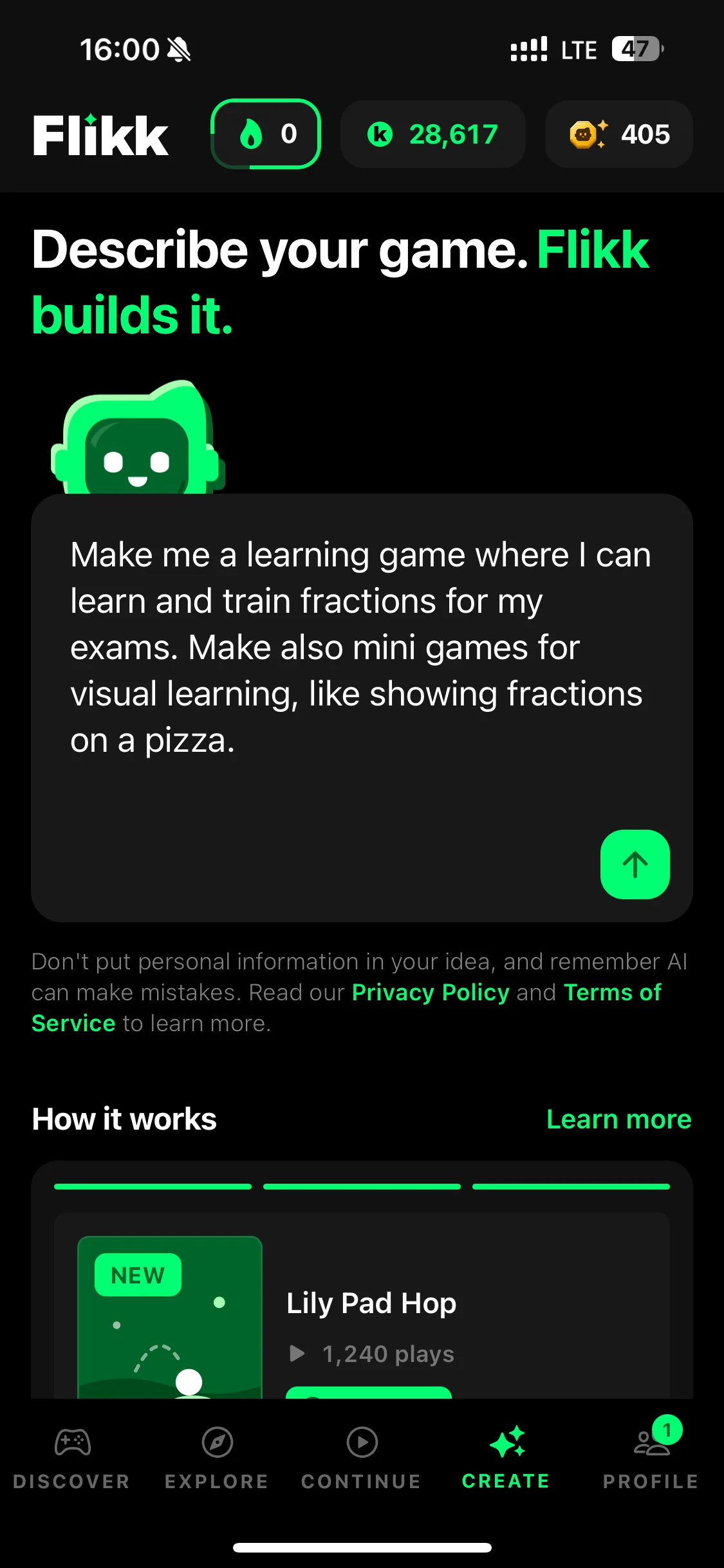
Make me a learning game where I can learn and train fractions for my exams. Make also mini games for visual learning, like showing fractions on a pizza.
That's it: two sentences. Say what you want to learn and how you want to see it.
Step 2: Check the game plan, then build it
Before building anything, Flikk wrote a game plan. It named the game Pizza Fractions: tap pizza slices to match target fractions, compare portion sizes, earn up to three stars per level for speed and accuracy. It also showed the cost: 100 Tokens, "Takes about 15 minutes to generate."
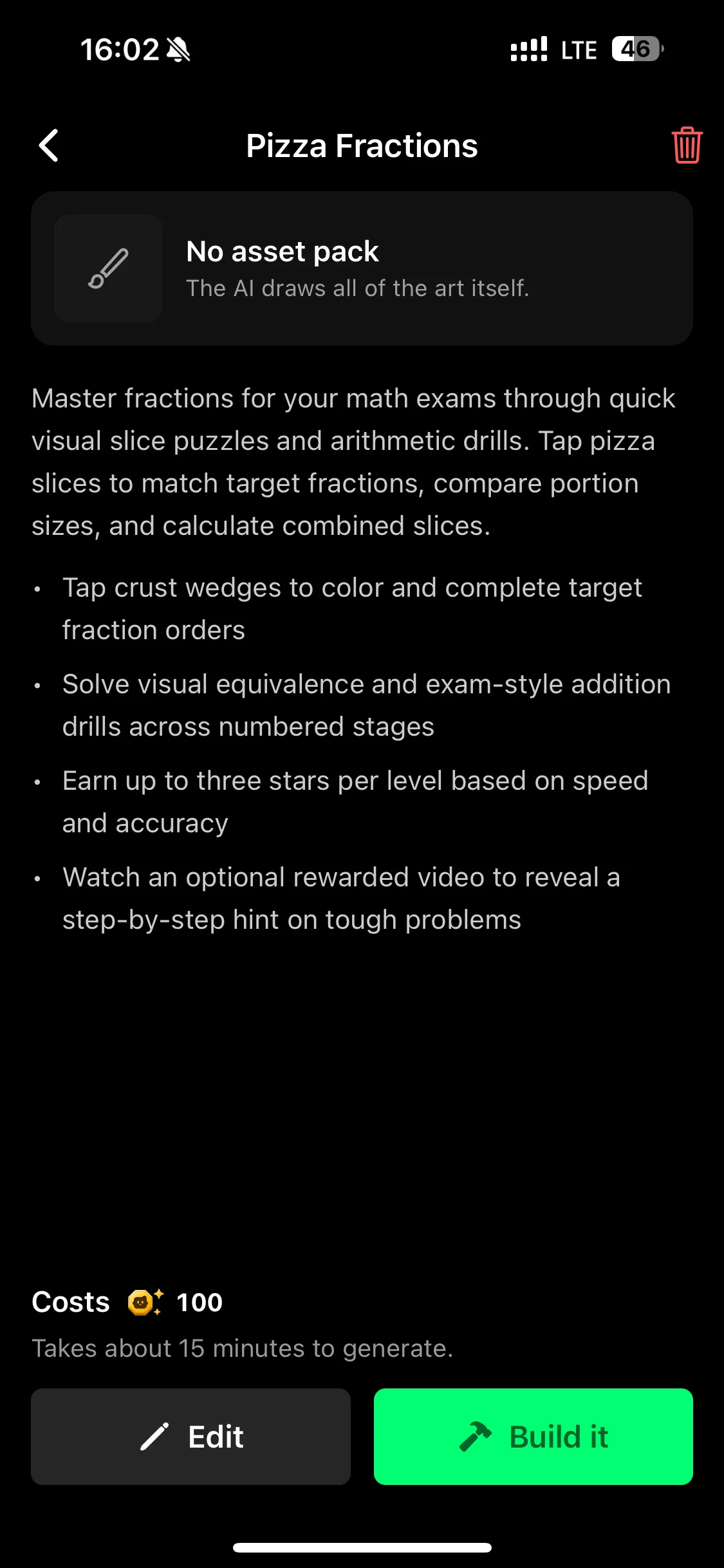
You can change the plan with Edit, but it already matched what I wanted, so I tapped Build it.
Step 3: Wait about 15 minutes
Flikk builds the game inside the app and shows how much time is left.
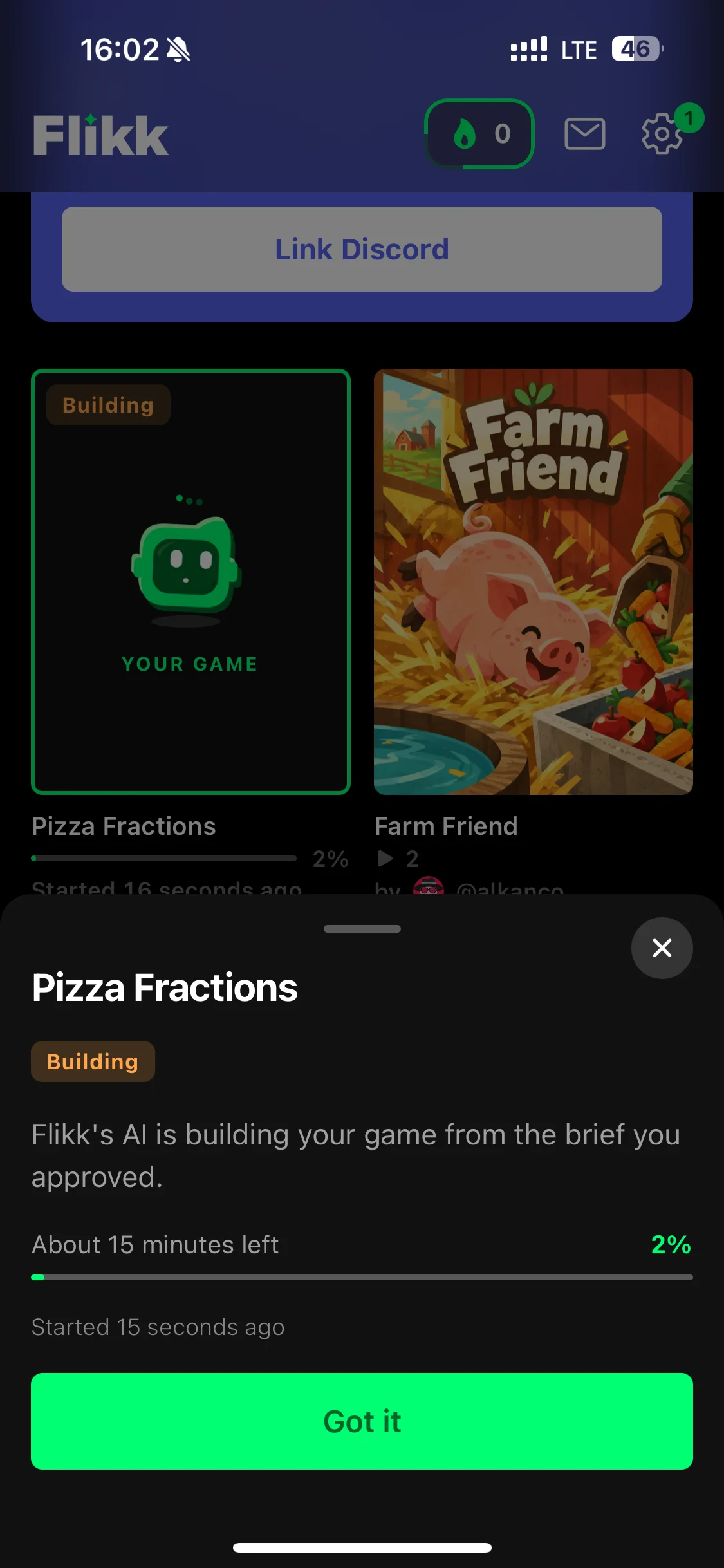
I tapped Build it at 16:02 and was playing at 16:16, so about 14 minutes.
Step 4: Play it
The finished game has a title screen ("Slice it. Solve it."), a "How to play" button and 40 levels.
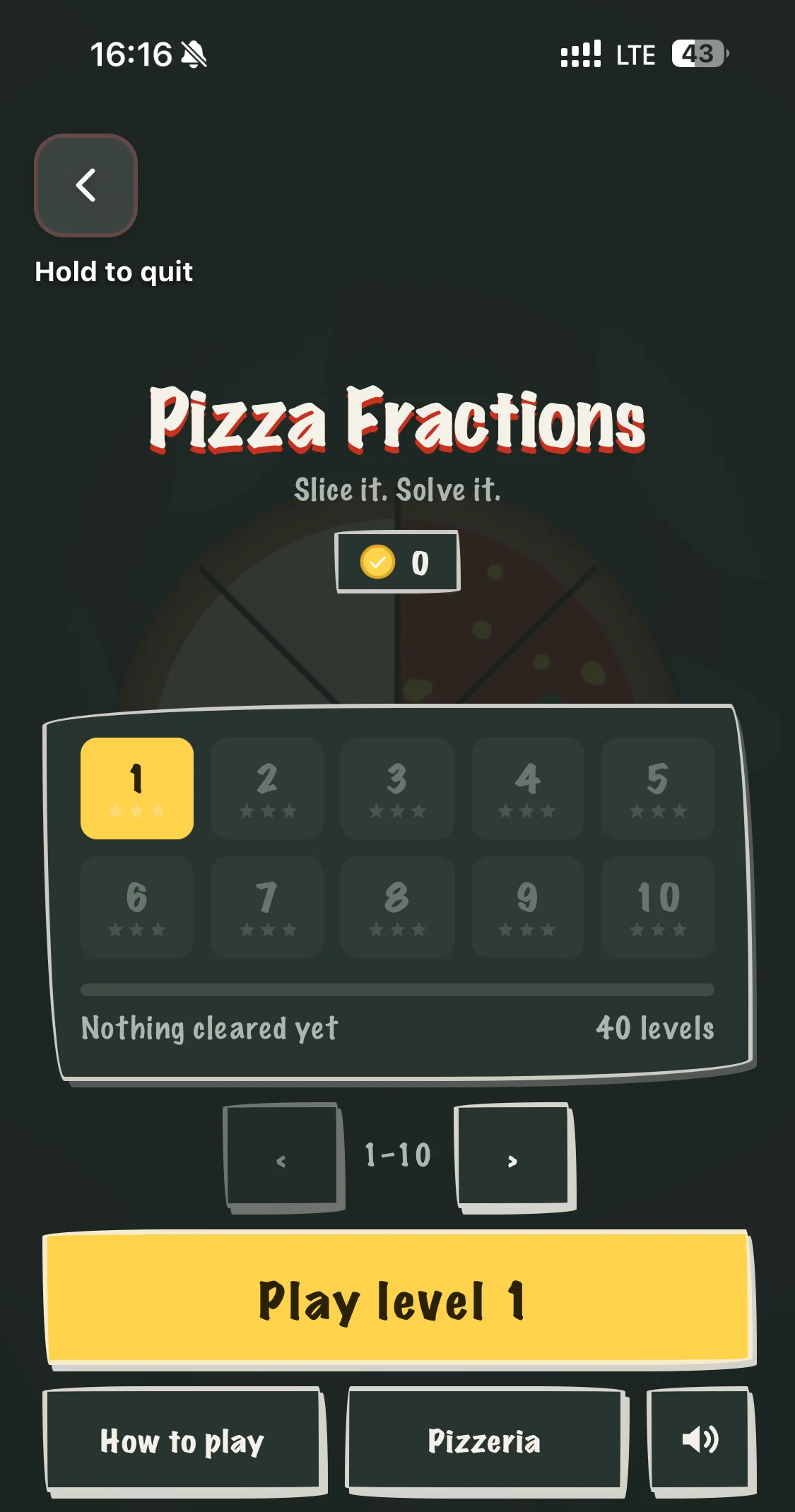
Each level is a short round of questions, and they come in different types:
- Fill this much pizza: you get a fraction and tap slices until the pizza shows it.
- What fraction is shaded? You see a pizza and pick the right fraction from four answers.
- Tap the bigger share / Tap the smaller share: two pizzas, two fractions, pick one.
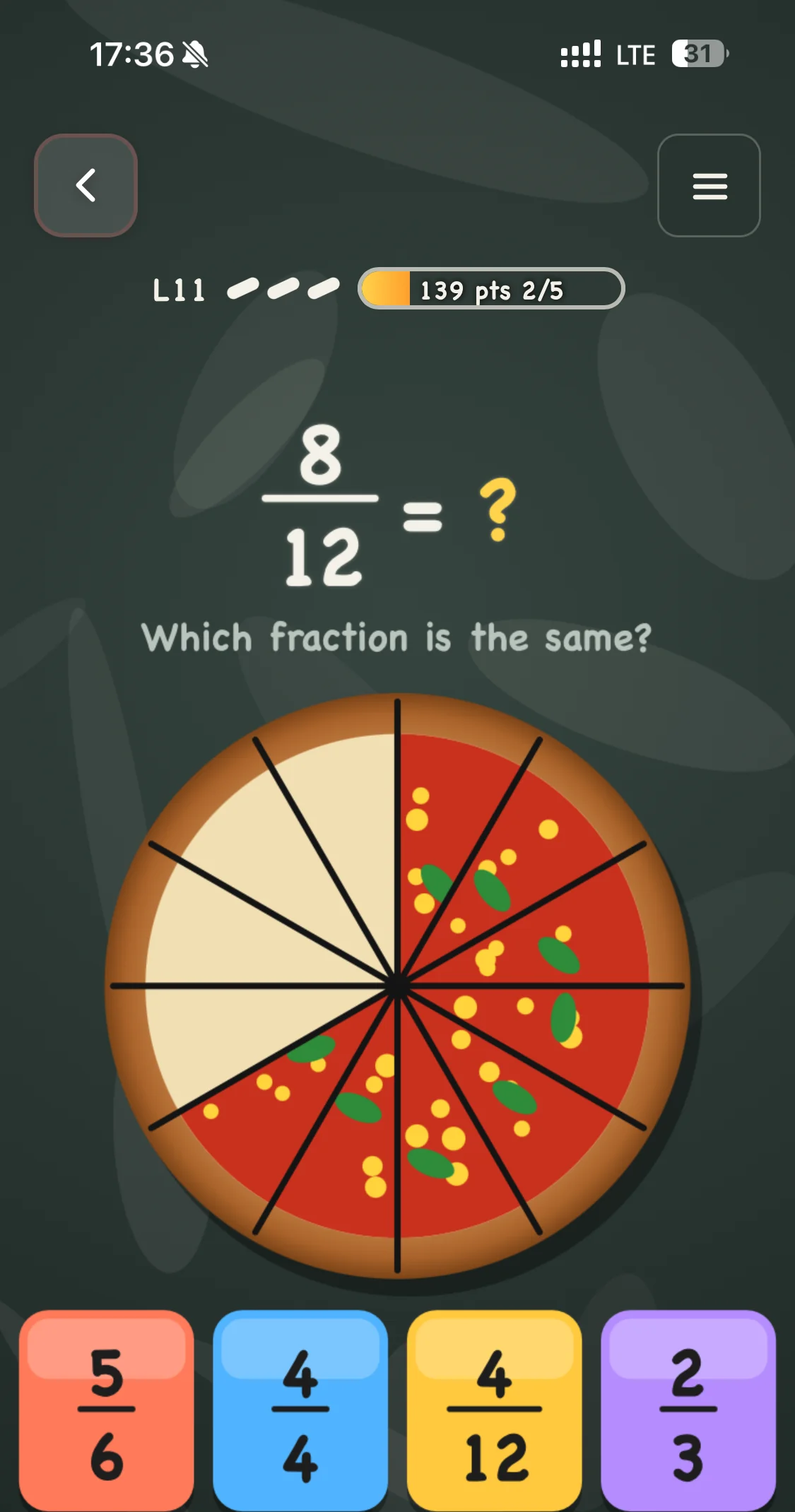
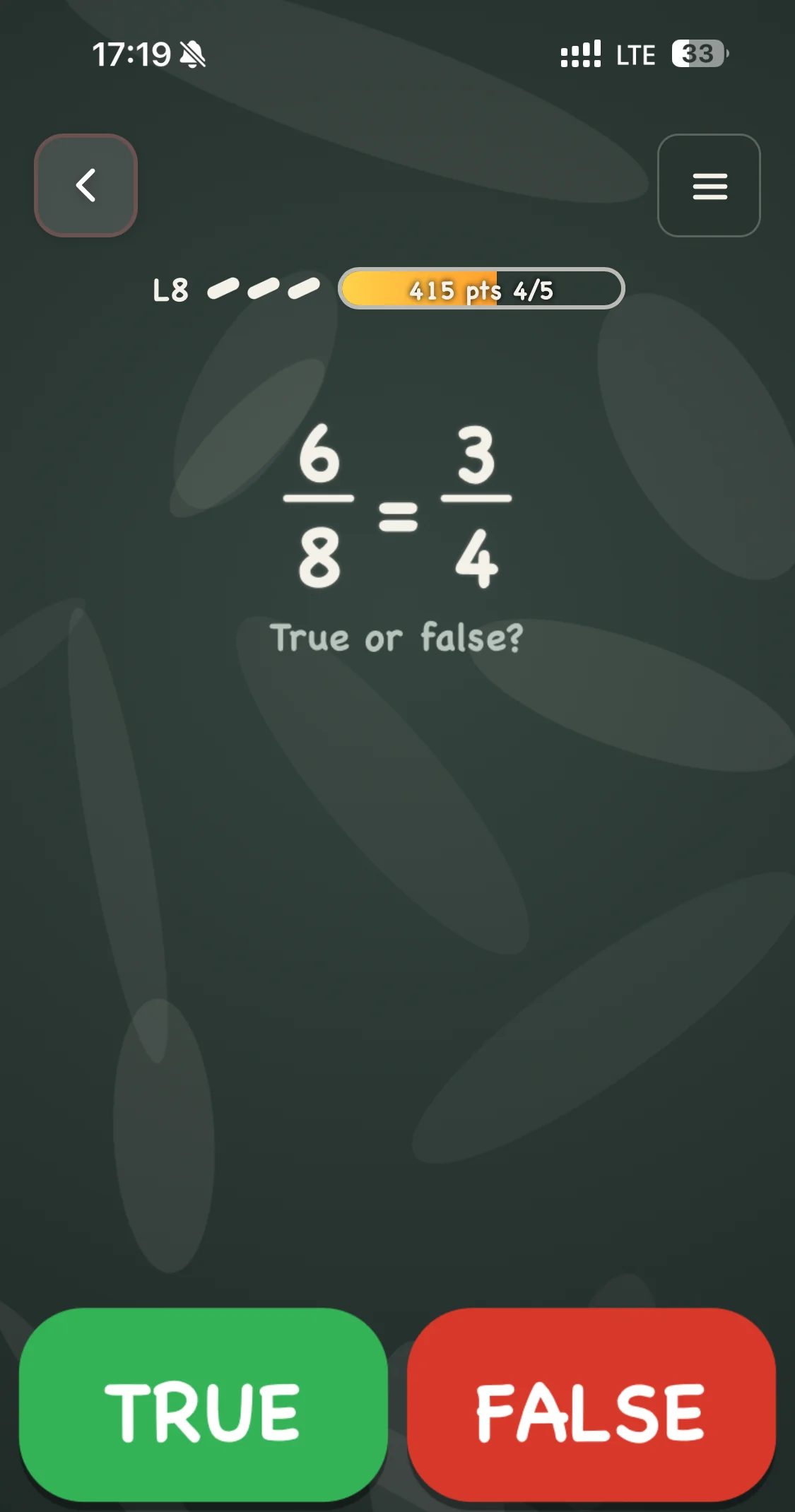
- Which fraction is the same? and true or false: equivalent fractions and quick comparisons (I added these later, see below).
One of the first questions in level 1 was my friend's mistake from school: 1/2 against 1/4. On the pizzas you can see the answer before you even think about the numbers.
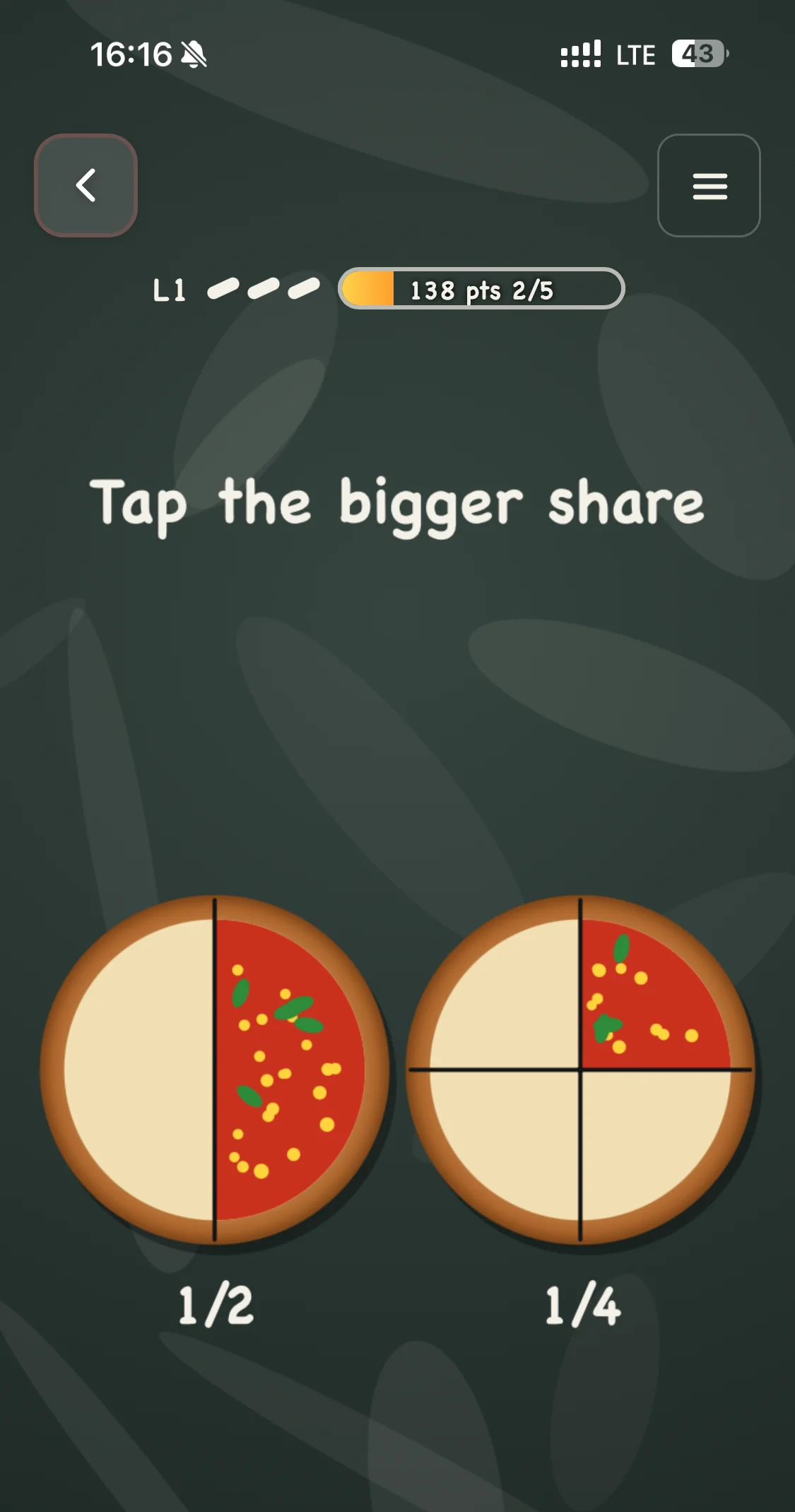
That's the point of the game. The number and the picture are on the screen at the same time, and you have to connect them.
Right and wrong answers
When you get it right, the edges of the screen flash green.
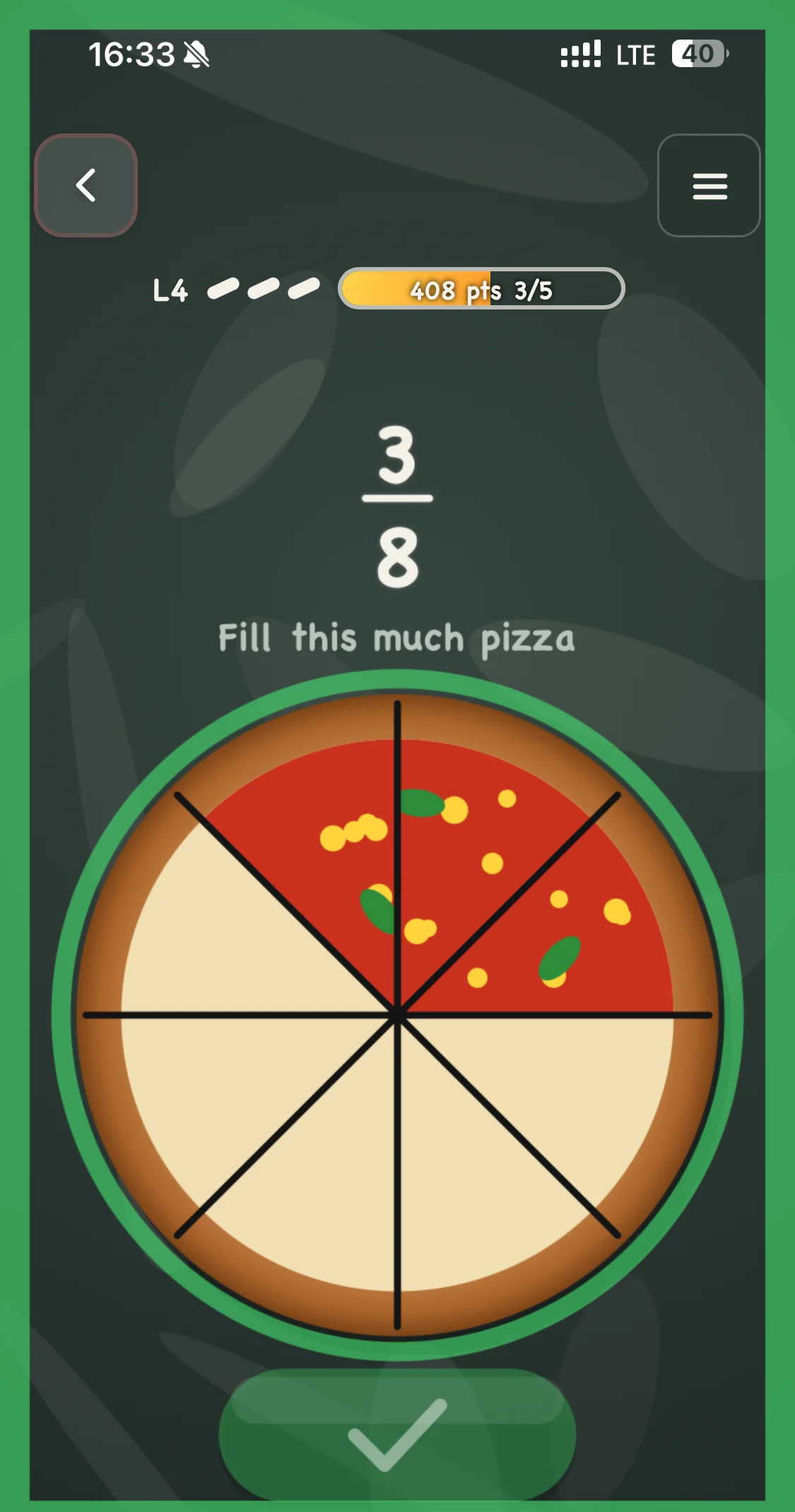
When you get it wrong, you lose a life and the edges flash red for a moment. Then you can try again. Here I was asked for 3/4 and only filled 2 of the 4 slices:
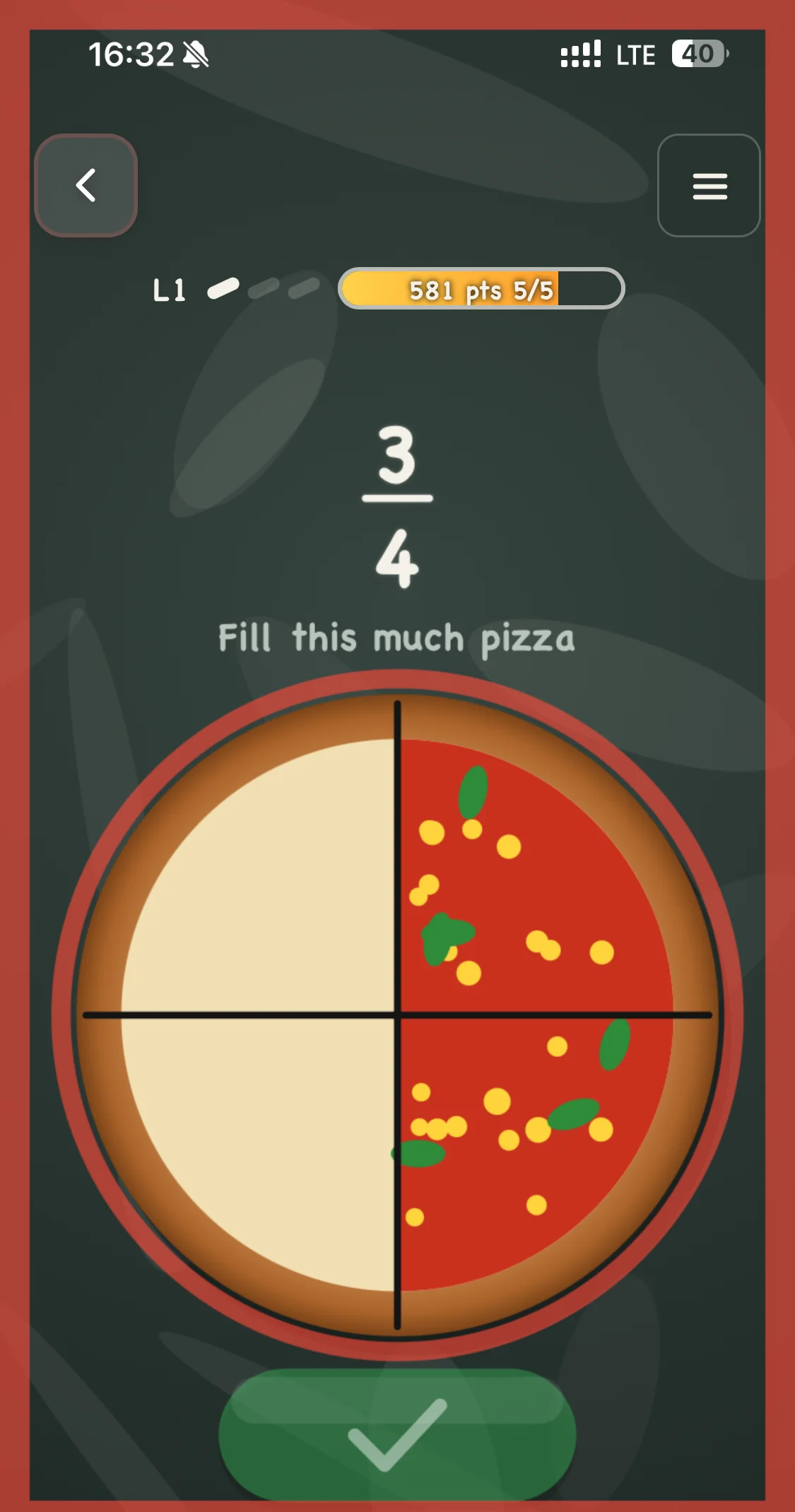
That little red flash is more useful than it looks. You see your mistake on the pizza, right next to the fraction, and you fix it yourself. That sticks better than a red mark on a test you get back a week later.
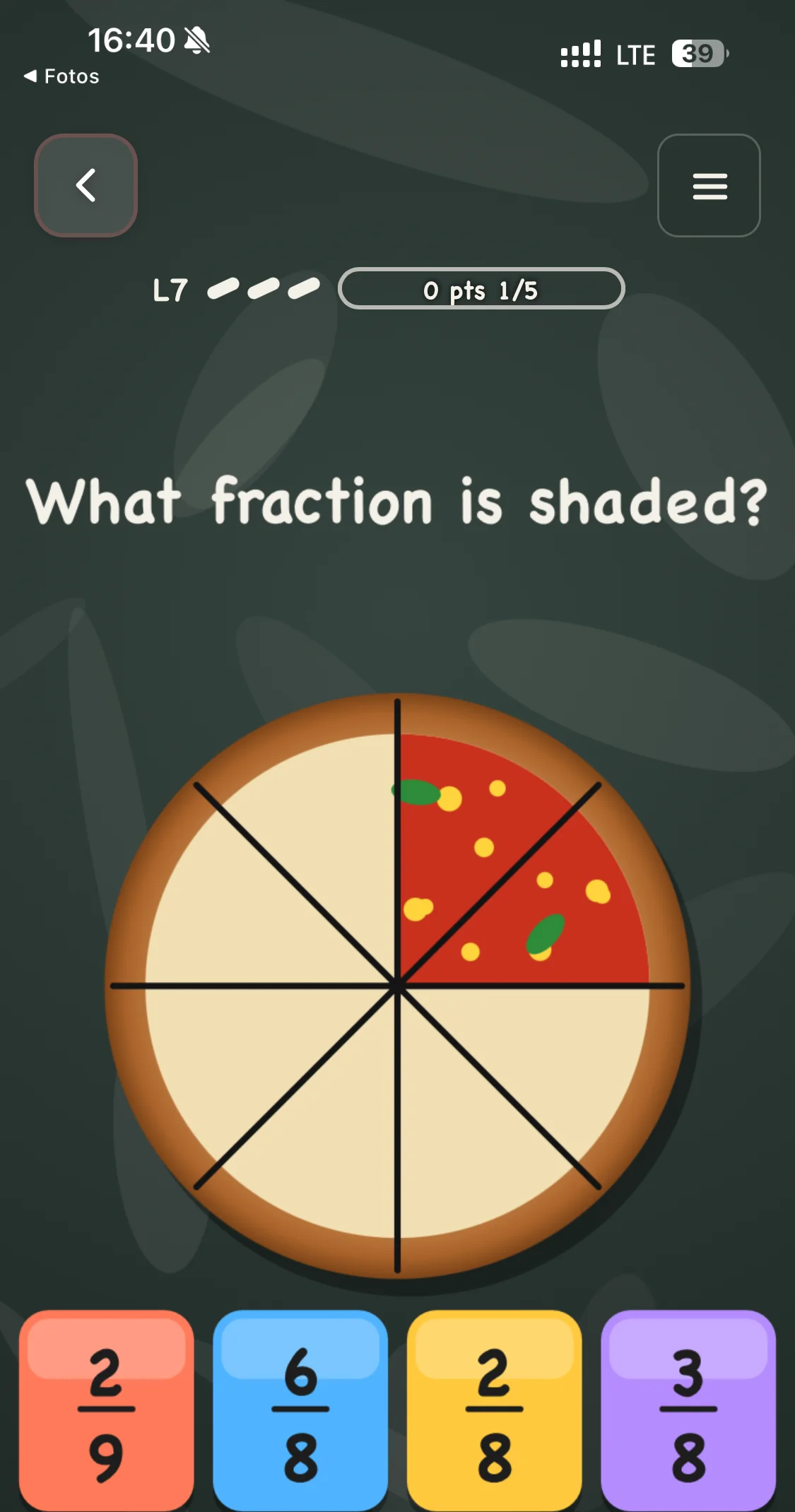
The "What fraction is shaded?" questions get harder in later levels, with pizzas cut into eight slices and answers that look alike (2/8, 2/9, 6/8, 3/8):
Make it yours: change the game with edits
The first version was right straight away. Once I'd played it for a while, I wanted two things: a smoother feel after wrong answers, and more question types, so it wouldn't get repetitive.
On your game's page there's a Make Edits tab: "Say what should be different in your game and the Flikk AI will change it." I made three changes:
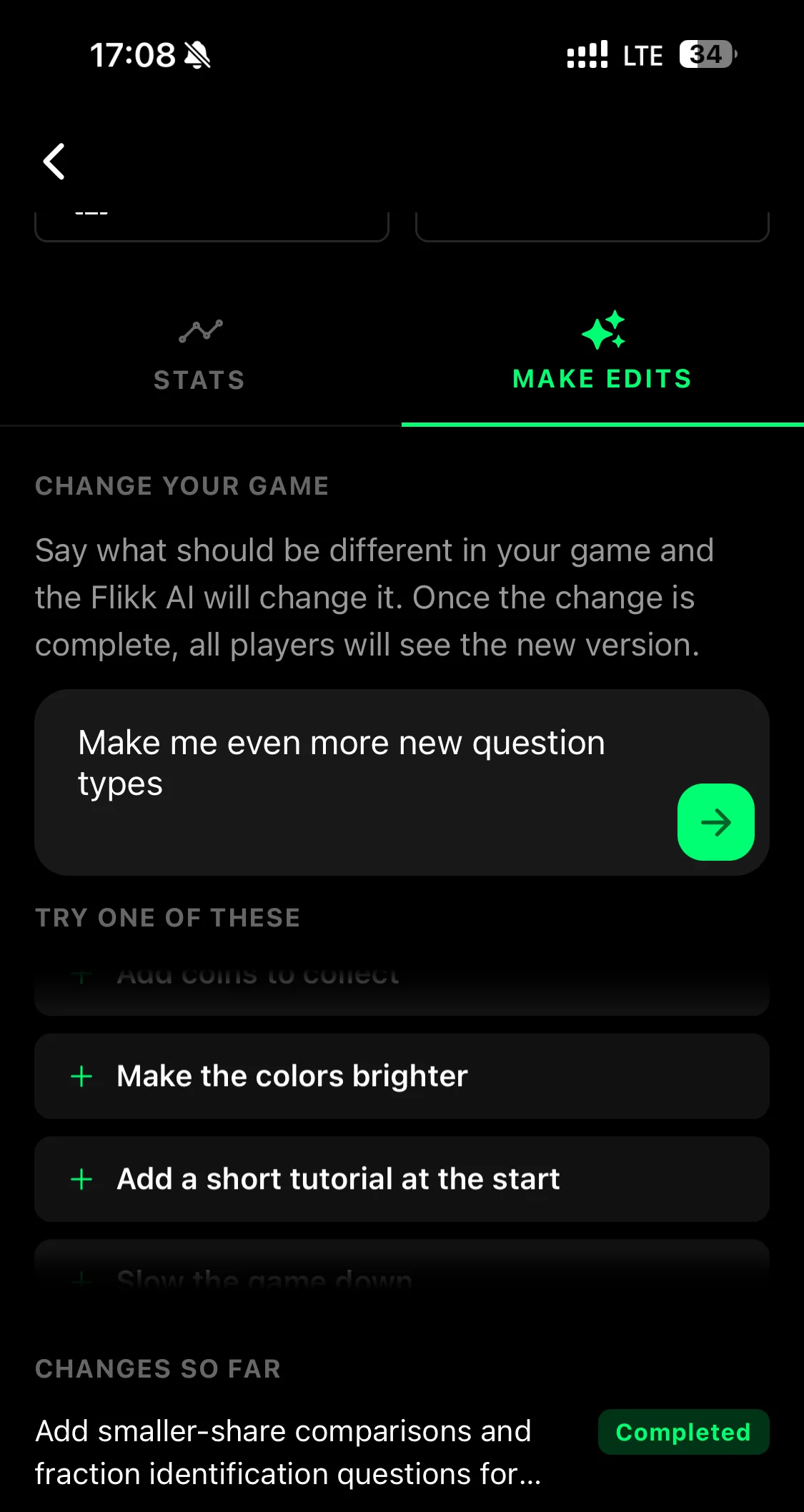
- Smoother wrong answers, so you can try again right away. Done in a couple of minutes.
- Add "smaller share" comparisons and "what fraction is shaded" questions.
- More question types. I just typed "Make me even more new question types."
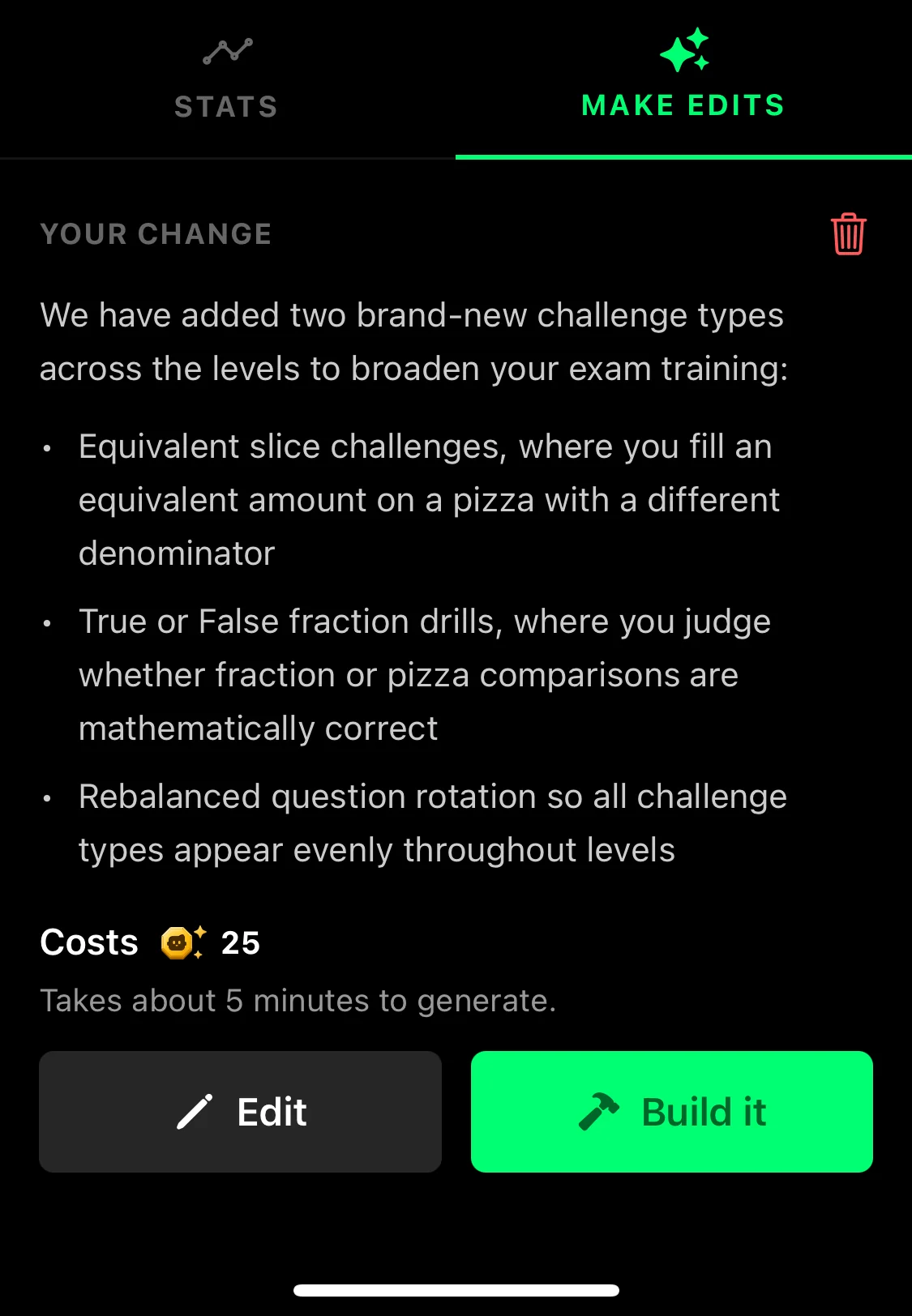
For that last one, Flikk again showed a plan before changing anything: equivalent slice challenges (fill the same amount of pizza with a different number of slices) and true or false drills. Each edit cost 25 Tokens and takes about 5 minutes.
Both made it into the game. On the left, an equivalent slice question from level 11: the pizza shows 8/12, and you pick which fraction is the same amount. On the right, a true or false question from level 8: is 6/8 the same as 3/4?
This is where making your own study game beats any ready-made app. Too easy? Ask for harder levels. Your teacher keeps asking about mixed numbers? Add them. Your exam is about adding fractions? Make that the whole game. The game grows with what you need to learn.
Ideas for other subjects
Pizza Fractions is just one example. You can build a game for anything you're learning, in school or at university. A few ideas to start from:
- Chemistry: "Make me a game where I build molecules by dragging atoms together, and it tells me if the bonds are right."
- Vocabulary: "Make me a game where words fall from the sky and I catch the right translation for my Spanish test."
- History: "Make me a game where I put events from World War I in the right order on a timeline."
- Biology: "Make me a game where I label the parts of a cell, and each level adds more parts."
- Physics: "Make me a game where I set the angle and speed of a cannon to hit a target, so I learn how projectile motion works."
- Computer science: "Make me a game where I sort numbered blocks step by step, like a sorting algorithm."
To be clear: I've only built the fractions game so far. These are ideas, not tested prompts, and your first version might need an edit or two, like mine did.
What makes a good study game prompt:
- Name the exact topic. "Fractions for my exams" works better than "math".
- Say how you want to see it. Pizza, cards, a timeline, a map. Pick what makes sense to you.
- Ask for different question types. Mixing them keeps you thinking instead of clicking on autopilot.
- Fix and expand with edits. Play it, notice what's missing, and describe the change.
If you thought learning was boring, try learning with a game you designed yourself. It feels very different.
Try it now
Pick the topic you're most worried about for your next exam. Open the Create tab in Flikk, describe a game that teaches it, and in about 15 minutes you'll be playing it. You can also play my game: search for Pizza Fractions in the app.
Download Flikk on iOS · Download Flikk on Android
FAQ
Can I make my own study game without coding?
Yes. On Flikk you describe the game in a sentence or two, for example the topic you want to learn and how you want to see it. Flikk shows you a game plan, and after you approve it, it builds the game in about 15 minutes. No code, no engine, no computer.
What subjects can I make a learning game for?
Any topic you can describe: math, chemistry, vocabulary, history, biology, physics, computer science or university topics. Name the exact topic and how you want it shown. If the first version isn't quite right, you can change it with edits.
How do I make studying more fun?
Turn what you're learning into something you do instead of something you read. A game gives you instant feedback on every answer and makes it easy to repeat a topic until it sticks. Making the game yourself means it's about exactly what you need to learn.
Is Flikk free?
Flikk is free on iOS and Android, and making games is free to start. Optional in-app purchases let you make more games or edit the ones you made. As of October 8, 2026, a new game cost me 100 Tokens and each edit cost 25 Tokens. Flikk is available in the US.
Can other people play my study game?
Yes. Your finished game lands in Discover, where everyone on Flikk can play it. You can also send it to a friend from your class and see who gets the higher score.